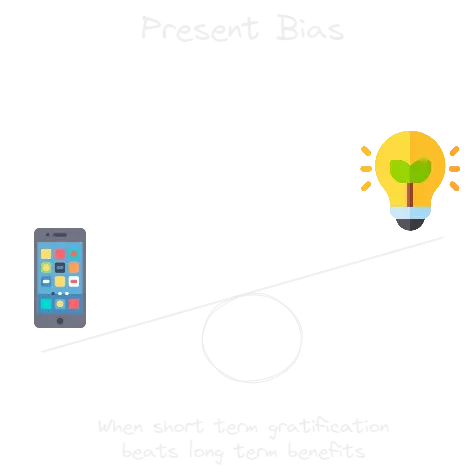
Present Bias
Notes
Claim
How much do we prefer the present over the future?
Explanation
When we have to make a decision between now and the future, we have a bias that originates from our current mentality, emotions and the Impulsivity is acting without conscious deliberation or filter for immediate gratification. That's why we also plan to do a workout "tomorrow", but when tomorrow comes we prefer to binge Insight Gap.
Why it matters
The ability to Delay Gratification is highly correlated with success, achieving goals and sticking to healthy habits. Because when that "tomorrow" comes and we have to choose whether to actually workout as we planned or rest, only by reducing our present bias and exercising Self-control is the capacity to regulate behavior against impulses could we be able to follow our commitments.
The goal is to align between our present and our future self. This requires some mitigation between our short term desires and our long term goals. Examples:
-
Commitment devices - we can use Commitment devices help enforce behavioral adherence through external constraints to make sure that our present self "stays on track" and aligns their behavior with the desired goal, while also automating as much as possible to reduce options of neglect
-
Make it fun - If the desired action is more enjoyable, the present self will be more motivated to do it Bundling undesired tasks with enjoyable activities increases motivation
-
Make it easy - Making the goal more realistic and less demanding would make it easier to follow through starting small. It's better to do a bit every day than trying to do it all and end up doing nothing.
Examples
When asked, most people would prefer 100$ now than 110$ in a week, although when asked if they prefer 100$ a year from now or 110$ a year and a week from now, most will chose 110$. Similarly consider the Marshmallow test, that you are offered a Marshmallow now or 2 if you wait 15 minutes. Most kids would take the 1 now instead of 2 later.
Supporters
However, there is some rationality in our present bias. Some would say that there is a cost to Uncertainty creates anxiety when knowledge and control are incomplete. What if I won't need the money tomorrow, but I'm sure I need it now? What if something happens/changes? Secondly, some say that when we think only in future terms (i.e 100 in a year, or 110 in a year + week) then only the rational part of our mind makes the decision, since it doesn't care about the "costs" of that action. It won't be the one who trains, the one who has to follow through. The emotions of the "present self" provide valuable information on our preferences, since it is our "present self" that will have to follow through and pay the costs of those habits/commitments.
Opposers
Unfortunately, constantly preferring the present over the future leads to bad Positioning. Preferring the present over the future might be affected by Uncertainty creates anxiety when knowledge and control are incomplete and What matters most is often less visible than what is salient. The less tangible and guaranteed that a certain future might come to pass, we prefer the certainty of the present, with the benefit and costs it brings.
Open questions
Visual