Status-quo Bias
Notes
Claim
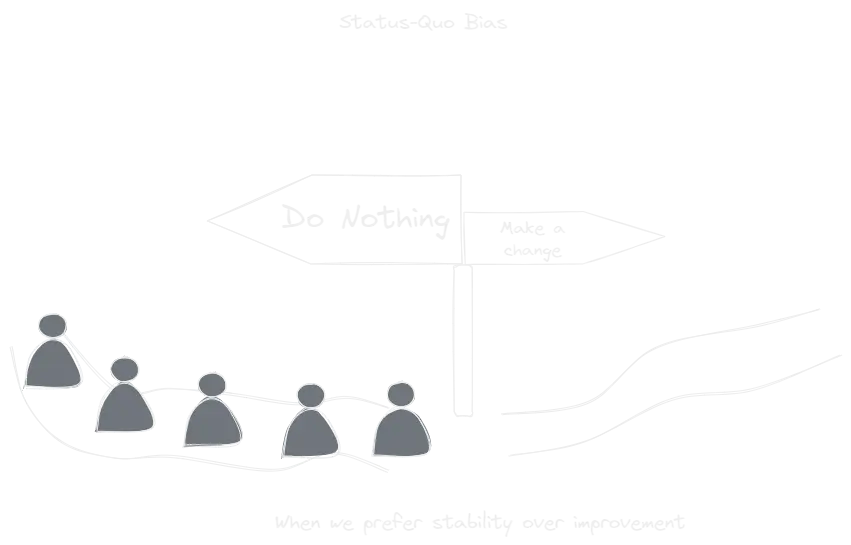
Status-quo bias is when we prefer the existing situation over changing it, despite being offered a better alternative. It is a sort of sticking with We tend to accept defaults and rarely override them in a Past choices constrain future options and behavior way.
Explanation
Perhaps it also includes a fear of Uncertainty creates anxiety when knowledge and control are incomplete, a preference for loss aversion, like the phrase "prefer the devil you know", even when we know that it could be better, we fear that it might be worse, so we prefer to keep the situation as it is even though it is far from optimal. It hides a form of Pessimism is focusing attention on negative outcomes and threats, thinking that if something is going to change, it will be for the worse.
Why it matters
Staying put isn't a neutral choice — it's still a choice, and it carries the same alternative cost as any other: the better option we didn't take.
Examples
Supporters
Those who prefer the status quo probably have a Fixed mindset assumes capabilities are unchangeable from birth, they believe that we are too bound by our circumstances that any attempt to change it will do more harm than good, or be a waste of them. It is also a form of Helplessness is perceiving no control over circumstances and outcomes, where we fail to take action to improve our lives.
We are highly affected by both Momentum is movement that builds self-reinforcing forward action that pushes us to stay in our course, and high Initial effort investments create friction preventing optimal behavior change that makes the first step, which is the most important one, the hardest to make.
There's also a subtler version of this: treating the mere fact that something exists as evidence that it should is-vs-ought reasoning. We don't just prefer the status quo — we quietly justify it.
Opposers
Choosing voice or exit over neglect or persistence is a direct rejection of this bias We respond to unsafe environments in four ways — it means we're willing to bet that change could make things better, instead of assuming the current situation is the safest one just because it's familiar.
Open questions
Visual