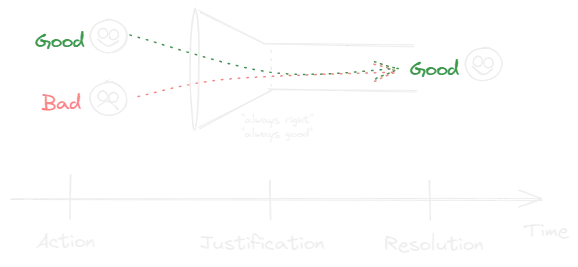
Rationalization
Notes
Claim
Rationalization is when we first come to a conclusion, and only after the fact do we find justifications to our actions Confusing current reality with how things should be blocks change, we use the situation as a justification, rather than first finding justifications which leads to actions.
Explanation
Most often, we use rationalization to justify our behavior (even and especially the bad ones), to maintain Merging actions with identity blocks growth, such that our actions would match our beliefs about ourselves. In essence, that means that we can't just rely on our Rational System, because it will always point out (by chance, of course) that we are right Preferring personal benefits blinds us to others' perspectives Conformation bias makes us accept confirming evidence without scrutiny.
Why it matters
It also corrupts our sense of agency: when we justify after the fact, we start to believe we chose deliberately, when really we're just making sense of something that already happened.
Examples
Sunk cost is a specific case of this: once we've invested time or money into a path, we keep going to avoid admitting the investment was wasted, even though the investment itself says nothing about whether continuing is still the right choice.
Supporters
However there are also potential advantages. This is perhaps the reason that Being emerges from action not belief works because if we act like the person we want to be, we rationalize it that we are truly becoming that person. change starts from the inside out.
Opposers
This method can be abused, your memory can change by being under pressure, by presenting false evidence, by conflicting our memories vs our tendency to be obedient. We can internalize false beliefs that led us to an action, and even make us believe we did something we actually didn't do. External influence constrains authentic identity and agency.
Similarly, this can be a tool that hampers growth and Taking active control rather than accepting circumstances passively. We justify the circumstances of our lives because it is convenient, it releases us from the guilt of having to do something about it, of suffering the blame knowing that our lives would have been better if we acted differently, causing us to stay in the status quo
Open questions
Visual