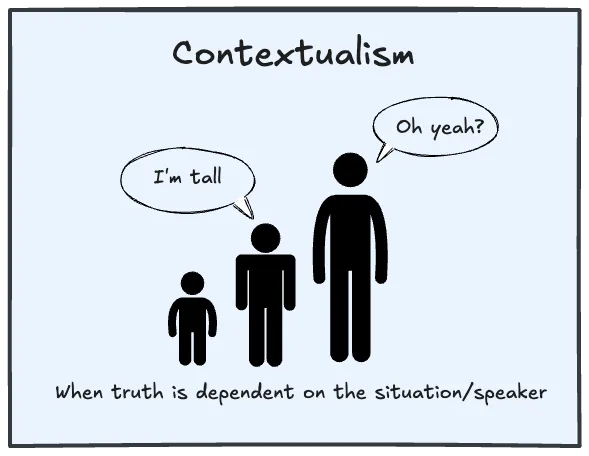
Contextualism
Notes
Claim
The Truth condition of a statement depends on:
- Facts - The physical, conceptual attributes of the known world. for example, "this table is 6 feet tall", depends on the actual height of the table, the definition of feet, etc. Seeing reality without subjective bias reduces distortion
- Context - the inner world of the agent, and it's perception towards the external world. Involves interest, beliefs and attention. For example, saying "He's rich" and "He's poor" can be both true at the same time depending on "what counts as rich" by the beholder. Actions and meaning depend on situational and environmental circumstances
Explanation
This solves the skeptical argument. On our day to day basis, it would be beneficial to act as if I'm not a brain in a vat, although in a highly skeptical context, I cannot know for sure.
In some sense, contextualism even if not correct, it is unavoidable, because it is based on our Subjective perception filters how we see external reality, we all carry different lenses through which we see the world, and that is how we can have multiple versions of "truth" Postmodernism rejects universal truth in favor of context-dependent meaning.
Why it matters
However, as with other cases of non binary truth conditions, it leaves us with little resources to find the truth ourselves. Since We can't read minds, the best we can know is our own truth, and not someone else's.
Examples
Supporters
If contextualism is true, than it supports Cultivating virtues creates a good moral character as the main (yet not only) meta ethics that gives importance to the person and the situation they are in, rather than just facts about the situation.
Opposers
In some sense, it opposes realism, because we can see that the claim that moral truths exist beyond human perception is difficult to match with the claim that truths are dependent on the context and specifically the speaker.
It also opposes Knowledge comes from empirical testing not innate reason, because empiricism assumes truth is an objective property to be measured the same way regardless of who's looking, while contextualism says the measuring itself depends on who's doing it.
Open questions
Is truth devoid of all meaning? If a short person says they are tall, are they correct? If they say something like "well compared to an ant I am tall", we can't say anything to refute it. Every sentence can be made true with enough manipulation. No wonders we have become indifferent to the concept of truth, because it lacks the meaning it used to have.
Visual