Pragmatism
Notes
Claim
Pragmatism is the idea that instead of seeing truth as something absolute, external, abstract, we need to view truth as a tool. Something is true if it "works", if it is useful to us.
Explanation
Therefore, pragmatism ties the idea of Utility quantifies measurable benefits and guides rational decisions to Truth, as opposed with Truth is discoverable through reason and logic alone and Knowledge comes from empirical testing not innate reason which both care about an absolute truth, and just disagree on how to get there.
Additionally, pragmatism brings forth the importance of action. Some philosophical debate seem very important, like the question of free will vs determinism, while they have no actual effect on our lives. Whether we believe in free will or not, we don't have access to the infinite facts required to see the deterministic path we walk on, so while philosophers might get stuck on that question, the pragmatist will ask "is believing in free will beneficial to us?". Most would say yes, that it is better to live in a way that believes in free will, because it gives us accountability and agency. It is like morality itself, there is no point in focusing on theory alone, because what matters is how it is implemented in our lives To be moral is to act moral. A pragmatist would always check if the idea is actionable, and which kind of results does it generates Experimentation, they will never be satisfied with theory alone.
Why it matters
Examples
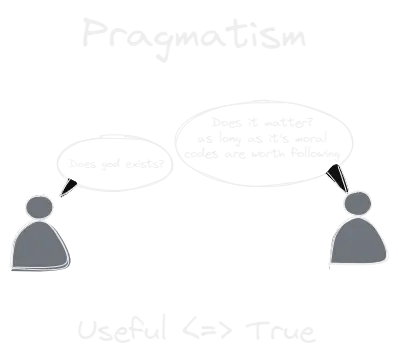
For example, a classic debate around religion would be whether god exists or not. For a pragmatist however, the better question would be - does religion, or being religious improve our lives? does it make us better people? If the answer is yes, then we should be religious, and view god and it's teachings as something that is true, regardless whether we were able to find evidence to it's existence.
Supporters
The more scientific concept of truth often overlaps with the pragmatist concept of truth because in order for something to "work" for us, it usually requires it to be real. For example, gravity is true because if we ignore it, the way we live, the buildings we build, will be very hard. To see gravity as true is useful, and it is useful because it is true/proven. It's not "by chance" that we have this circular reasoning. As mentioned, when something is proven as true, then it is also pragmatically true Seeing reality without subjective bias reduces distortion.
Opposers
At first glance it seems that pragmatism is related to What is moral depends on the viewer, because when we talk about "usefulness", we mean useful to us. For example, religion can make one person better off, while the other does not. In that case, it is true to one person and not the other. However, while there are some edge cases, generally pragmatism is not relativist. Where pragmatism shines is in the opposite direction, that we consider as true things that have not yet (or can't be) proven scientifically as true Flipping assumptions reveals hidden possibilities and better solutions.
Open questions
Visual