Truth
Notes
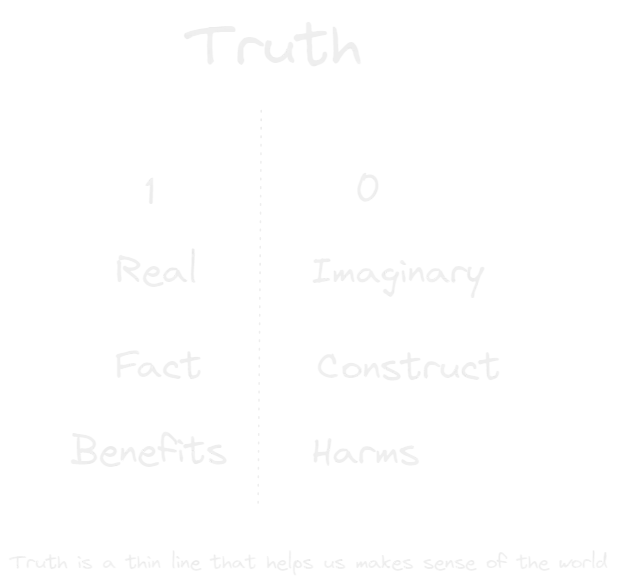
Truth seems like an obvious concept to ask about, but it isn't. We assume truth tracks reality — that some things are simply facts, like the current temperature of a room or the amount of spoons in a drawer. But those easy cases turn out to be the exception, not the rule.
What makes truth hard to pin down
Four cases resist easy answers:
-
Statistical facts - In most cases we don't have direct access to all the data we need to find out what the truth is. For example, to say that the "human body is 70% water", does it count as truth? Not only is it based on a sample, rather than the entire population of the world Population and sample estimates (never mind it's constantly changing), but also we have Bias and Variance, meaning that my body can be 60% water, and yours is 75%. All the facts that we "know" from scientific experiments are just that, experiments done in a specific setting with a limited sample. And as the Empirical testing not reason alone discovers truth likes to point out, it might be found out as false in the future. So are those facts "true"? Perhaps not.
-
Abstract concepts - What is the truth value of "justice"? What is considered a work of art? Do these claims even have a truth value? Some claim that they do, that truth can be connected even to abstract concepts that have no "physical proofs" in reality. Objects imitate a perfect version of themselves
-
Matters of perspective - If I say "it's cold here", while my friend says "it's hot here", who is right Truth depends on context and the observer's perspective? Is it only a matter of the room's temperature? Is none of us right, or both of us? It feels wrong to say that only one person is right, but it also feels strange to say that both of us are right, that truth can be both one thing and its opposite, or relies on our Subjective perception filters how we see external reality. It can make truth sound less like a matter of fact and more like a matter of opinion.
-
Actual or practical? - Does truth have to be related to a tangible, physical concrete fact, or does a Shared beliefs make constructs real and true also count as "true"? For example, money has no value other than our belief that it does. On the one hand, it sounds weird to say that the value of money is a true fact, yet we use it every day and it is an inseparable part of how we think and act Truth and goodness are defined by practical usefulness
Truth under disagreement
While Deliberation is a discussion that bridges different perspectives is a useful strategy overall to "find" the truth, we might fall prey into Group Thinking. Therefore we might be forced to Debate treats disagreement as a zero-sum game on what the truth should be, making sure we are not blocking out voices that oppose us but rather listen to them carefully, giving them an attempt to persuade us and vice versa. Freedom of speech enables open deliberation and underpins democratic society
Visual