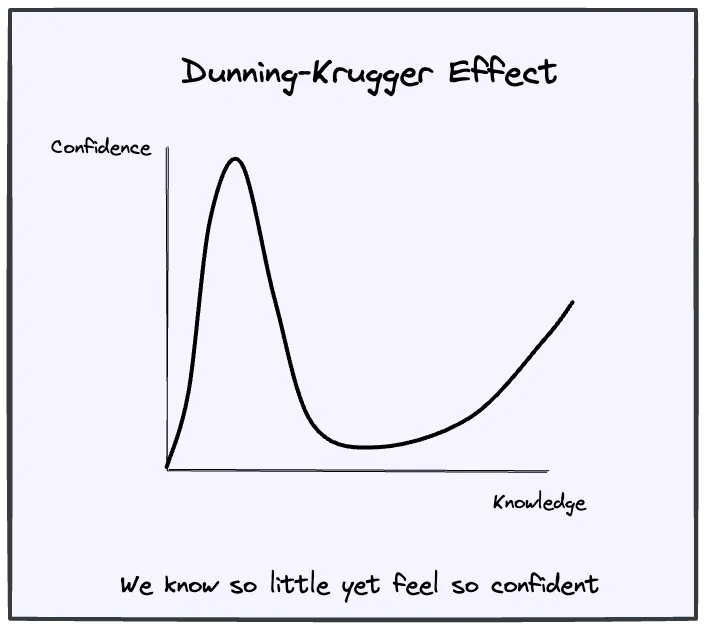
Dunning-Kruger Effect
Notes
Claim
The less you know, the more confident you are in your knowledge.
Explanation
- Ignorance - at first we are unaware of the depth and the amount of knowledge that a given field contains - the "unknown unknowns", so we are not able to accurately evaluate how much we know, and we tend have Overestimating abilities blinds us to genuine risks in our knowledge/capabilities
- Cultured - in the second stage, although our knowledge increased, we are aware of the "known unknowns", thus reducing our confidence in this topic significantly. This can also generate the Imposter syndrome is feeling undeserving despite actual competence because we allow our lack of knowledge reduce our confidence, even though we are more knowledgeable than the average person.
- Expert - only on stage three, our confidence matches our expertise once our knowledge has caught up with most available/relevant knowledge in this area. Notice that even in this stage there is a confidence gap from stage 1.
Why it matters
Only by forcing us to confront with our lack of knowledge we are able to admit it.
Examples
Supporters
Humility is what stage three actually looks like from the outside — once our confidence catches up to our knowledge, we're finally honest enough to admit how much we still don't know.
Opposers
Open questions
Visual