Experience Knowledge
Notes
Claim
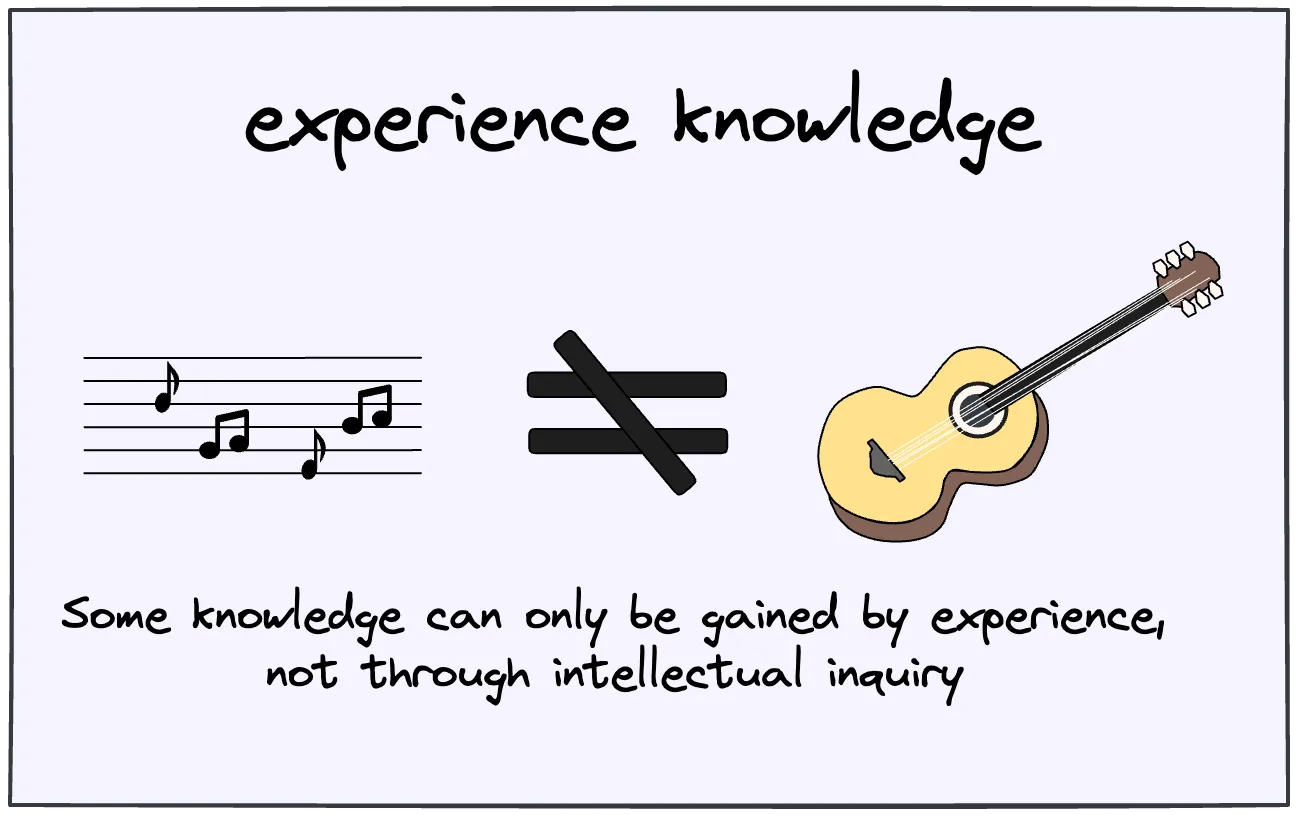
Experience knowledge differs from intellectual knowledge by the fact that some knowledge can't be obtained through lectures, books, and teachers. Some knowledge can only be gained through experience Active engagement turns information into knowledge.
Explanation
There is something about actually being in the situation that changes us, that affects us. We learn by doing. Perhaps it's the What matters most is often less visible than what is salient of it, when we can see how our knowledge comes into practice we can understand it better. Perhaps it's a matter strong and immediate Feedback is information that enables behavioral improvement. We won't know that we play the cords wrong until we try it, and the annoying sound that we'll make would be a strong, memorable evidence for that.
This is the heart of the Some knowledge requires experience argument. Even after hours of studying, you can't have a complete knowledge about colors without seeing them. This is also related to the Subjective experience resists scientific explanation, because experience is something that is hard to quantify by science.
Experience knowledge has the following attributes:
- complementary - experience knowledge doesn't replace intellectual knowledge, but rather is complementary to it. A good surgeon needs to know both what their goal is, and how to achieve it. Learning cords is essential for playing music.
- Physical - In most cases, experience knowledge has a physical aspect to it. Suggesting that not all knowledge is located in our brain, but rather in our body Thinking extends beyond the brain to environment and society
- Emotional - while the physical aspect can be the medium of this knowledge, usually the output is an emotional state. Whether as an abstract Intuition is trained expertise converted to automatic response, or a sense of connection to the relevant field, or the opposite, an inoculation to the emotions existing in this experience. A firefighter has to learn how to be brave, a surgeon has to be cool-headed, while a musician has to be "as one" with the music. creating a sense of Flow is deep immersion where performance peaks and self-awareness disappears
Why it matters
Examples
You can learn hours of music theory, but you won't know how to play the guitar until you will actually hold one.
Supporters
Opposers
Open questions
Visual