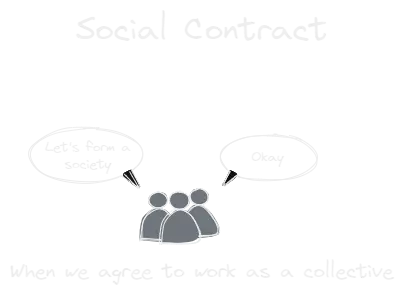
Social Contract
Notes
The social contract asks a foundational political question: on what terms do individuals agree to live together under shared rules? Unlike a literal contract, it is a theoretical device — a way of asking what people would have agreed to if society had been designed from scratch.
The Logic of Mutual Agreement
At its core, The social contract is a conditional agreement to exchange freedoms for collective benefits. Individuals surrender some natural freedoms — to act without limit, to take what they need by force — in exchange for the security and coordination that only collective life provides. The shape of this agreement, however, is not fixed. It depends entirely on how the designers of the theory conceive of Human Nature (Map): Hobbes's fearful, combative human produces a contract that demands a powerful sovereign; Locke's rational rights-holder produces a limited government obligated to protect pre-existing liberties; Rousseau's naturally good but corrupted human produces a democratic general will as the only legitimate authority.
The Problem of Consent
The most persistent challenge to social contract theory is whether consent is real. The theory invokes Consent requires explicit verbal confirmation — the idea that agreement must be meaningful, not merely assumed. But newborns cannot consent, and adults who reject the society they were born into face prohibitive costs of exit. Consent to the social contract is coerced, not chosen: rather than freely agreeing, most citizens are shaped from birth to experience social rules as natural and inevitable. This is not a bug in the system but, on some readings, its primary mechanism of stability.
Visual