Simulations
Notes
Claim
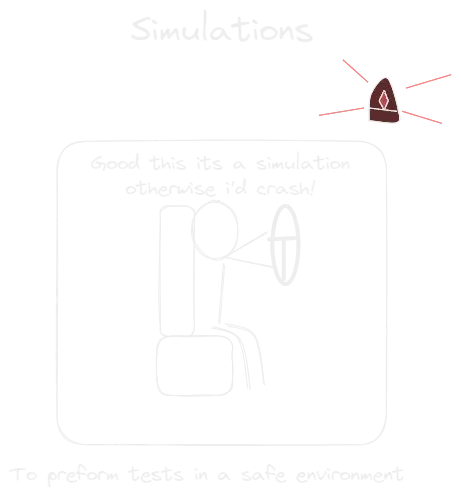
Simulations are safe environments in which we can conduct experiments. Usually the goal of simulations is to gain Some knowledge requires direct experience to fully understand through simulating as best as it can reality itself.
Explanation
The advantages of simulations are providing necessary knowledge that couldn't be available in a regular class setting, while avoiding the risk of testing our knowledge in "real life". The more "realistic" the simulation, the better Feedback is information that enables behavioral improvement it will provide for the learner.
Why it matters
Other advantages of simulations:
- Cheap and easy - testing in real life can be costly in more ways than one, while simulations are relatively low cost. Even a Pre-mortem anticipates failure modes to enable preparation can be perceived as a type of simulation, where we try to imagine how the choice unfolds in the future and what are the potential risks. Cheap also means that it is easier to Generating multiple alternatives simultaneously improves outcomes - to test multiple ideas/methods/directions simultaneously and see which is best. Similarly, it is easier to follow our Curiosity is the joy of filling knowledge gaps and test ideas we didn't have the courage to test in real life.
- Hands on learning - as with other types of hands on learning, running simulations instead of using only theory based learning is better in terms of learning efficiency, because they learn by doing.
- Failures are welcomed - One of the reasons we hate to fail is because of it's consequences, the damage to our ego, the setback it poses on our growth, etc. In simulations, failures have no consequences, and are even welcomed because they are part of the learning process, so we have an easier time developing a more healthy perception towards Failure is a necessary part of learning and growth.
Examples
For example a pilot who learns to fly through a simulation instead of flying a real plane.
Supporters
Simulations are often used in Deliberate Practice is the best way to develop skills, for example Olympic swimmers who not only practice in pools of the same size as an Olympic pool, but also test different problems that can arise, like what if your goggles fall down.
Opposers
However good the simulation, it's still one step removed from the real thing - and Direct practice transfers skills better than indirect study holds that skills transfer best when practiced under the exact conditions they'll be used in, not a stand-in for them.
Open questions
Visual