Solve the Easier Problem
Notes
Claim
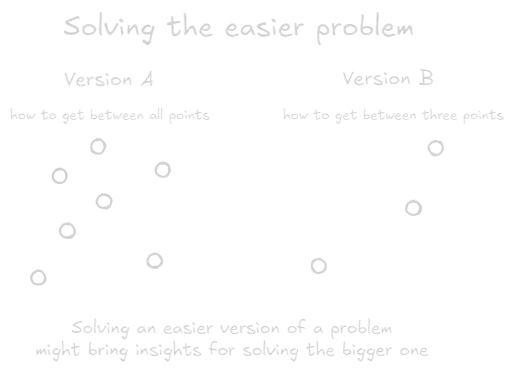
Some Problems appear too hard or too complex to solve, or situations where change seems impossible. Instead of trying to do the impossible, or fight against the current, we can first try to solve the simpler situation. Challenge
Explanation
In computer science, this is called "relaxation", where impossible optimum problems are solved by reducing some of the limitations.
Why it matters
Ask yourself two questions:
- what works currently? and how can I use it for my benefit?
- what if my main challenge was gone, and only the minor ones left?
In practical terms, this can be deconstructing either the input or the output, for example: what if instead of doing 5 workouts a week, I will try to do just one just one? 5 minute rule or instead of trying to do the most demanding chore at night when I'm tired, I'll try to do it in the morning when I'm fresh?
In the world of decision making, it often means to reduce the problem to a few quantifiable metrics. For example, instead of asking yourself what career to pursue, you ask yourself which job pays more.
Examples
Supporters
Opposers
The problem is that some decisions lose much of their depth in this process, and we often stick with quantitative metrics and abandoned qualitative metrics Treating measurable metrics as complete truth hides importance. We focus on what's easy to measure and compare, and not necessarily what's important
Open questions
Visual