Shallow Copy
Notes
Claim
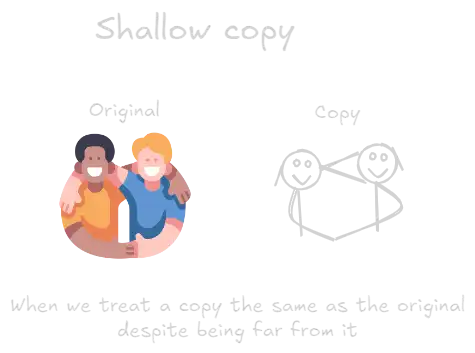
When we mistakenly believe that a mere copy is either a full representation of something else or even the thing itself Treating measurable metrics as complete truth hides importance.
Explanation
For example - a map is not the territory. It features some aspects of it, but not the full picture. During the creation of the map, some details are lost by necessity Distilling separates essence from noise to simplify understanding.
A copy can never be "as real" as what it represents, because in terms of information, we can't distill something without aggregating or removing some of that information. Similarly, when creating a copy, it necessarily goes through the subjective lens of the person who creates it. An architect, a bike driver, and a delivery person would all focus on something else when creating a map, leading to a partial, distorted representation of it.
It seems logical to say that every proxy is by definition a shallow copy of the "perfect" thing Objects imitate a perfect version of themselves.
Why it matters
Examples
Similarly, some people follow shallow copies as the meaning for their lives, like workaholics, without seeing how their choice is a shallow copy of the real thing Surrendering agency to external forces destroys individual identity. Unfortunately these shallow copies are often more inviting than the real thing, because it focuses on the image rather than the core. For example - immersing yourself in a language is hard, but playing a language learning app is fun, even if it is less helpful.
Supporters
However, sometimes we would want to purposefully use a shallow copy, because it is much easier to make and understand relaxation. Without google maps we would get lost, even if it is just partial information.
Opposers
Open questions
Visual