Invisible Hand
Notes
Claim
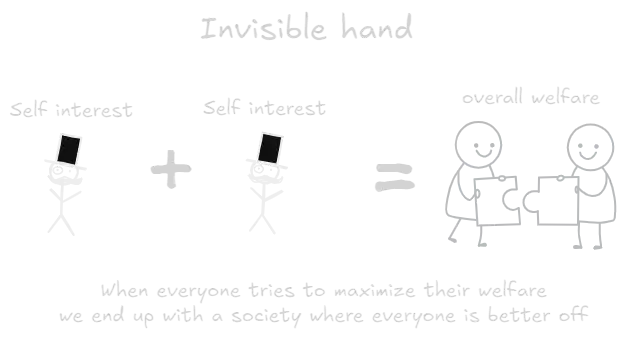
The invisible hand is a famous argument made by Adam Smith that claimed that out of selfish Incentives shape behavior by making certain actions more attractive we could achieve prosperity.
Explanation
Why it matters
Examples
For example, the bread maker wants to sell more bread, so they are incentivized in creating bread both in quantity and quality so that it would sell, and in a competitive price too. It's not because they are generous that we reach a situation of abondence of food in good prices, but rather because they are selfish. This argument relies on everyone competing equally Competition without chances of Moral Hazard.
Supporters
This tracks with a broader pattern too - Appealing to self-interest triggers stronger emotional investment tends to work better than appeals to generosity, which is exactly why the mechanism holds even when people aren't especially altruistic.
Opposers
For example, if the bread maker can become a monopoly and eliminate their competition they could produce a low amount of bread in high prices that would benefit their pocket but not the general welfare.
It's also not the only route to collective benefit - cooperative arrangements can reach similar win-win outcomes without relying on competition or self-interest at all.
There's a more corrosive cost too - leaning on self-interest as the default mechanism can displace kindness itself, replacing it with cold calculation even in places it wasn't needed.
Open questions
Visual