Limits
Notes
Claim
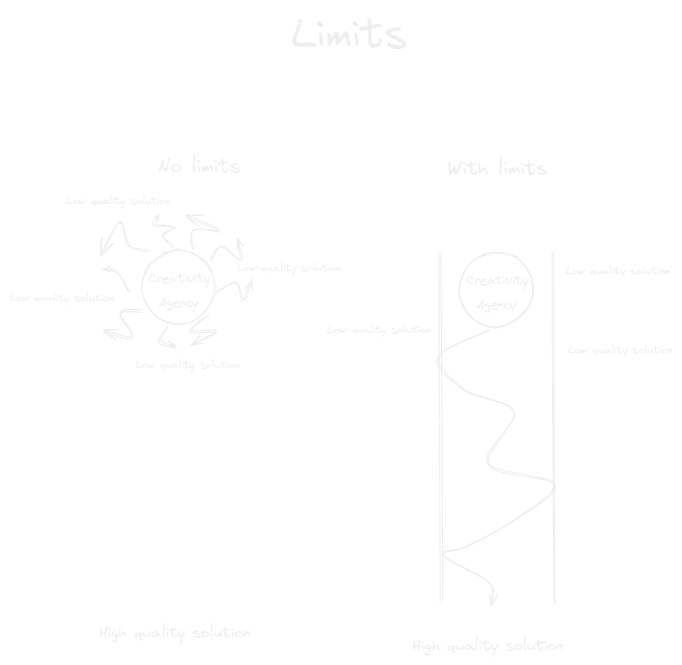
Limits are in essence an embodiment of Improvement often comes from removing rather than adding. By posing limits on ourselves, we can increase our ability to act, our psychological freedom, and our creativity.
Explanation
- Ability to act - The most common example are Commitment devices help enforce behavioral adherence through external constraints, where you set restrictions upon yourself, only to be able to fulfill your "true desires" Self-control is the capacity to regulate behavior against impulses.
- Psychological freedom - this is related to Flipping assumptions reveals hidden possibilities and better solutions, when we "force" ourselves to think from a different perspective, we gain the ability to tap into new insights
- Creativity - Sticking with the first thought that comes to our mind is usually far from the best option First attempts are inherently lower quality than iterations. Therefore, by forcing ourselves to try again Generating multiple alternatives simultaneously improves outcomes or imposing limits on the characteristics of the potential solution, we increase the chance of finding a more creative one. For example, people who tried to come up with a good company name, managed to find better names when told that they can only use 5 letters, instead of no restrictions.
Why it matters
Although they have a tendency to lead to Resistance emerges when people feel controlled or pressured, limits are often positive in our lives. Instead of pushing towards lower Friction is resistance that blocks action and behavior adoption, or trying to solve relaxation problem, actually adding Complexity makes ideas harder to understand and implement is better for us. We need Boundaries reduce ambiguity by clarifying mutual expectations so that we could be completely free within them Safe Base provides security enabling growth and exploration
Examples
Turning a chore into a made-up challenge works the same way - trying to wash the dishes using as little water as possible is a self-imposed limit that turns a dull task into an interesting one.
Supporters
The same logic runs in reverse too - choosing your own limits is often what actually frees up the ability to act on what matters, rather than getting in its way.
Opposers
Not everyone would agree the trade is worth it, though — the whole idea of negative freedom is about tearing shackles down, not building new ones, even self-chosen ones Freedom from external constraints. Somewhere between the two views is probably the honest answer: which limits set us free depends on whether we picked them ourselves.
Open questions
Is there a point where a limit stops liberating and starts Creativity can't be forced - where the "constraint sparks creativity" logic breaks down and the imposed structure just gets in the way instead?
Visual