Spaced Repetition
Notes
Claim
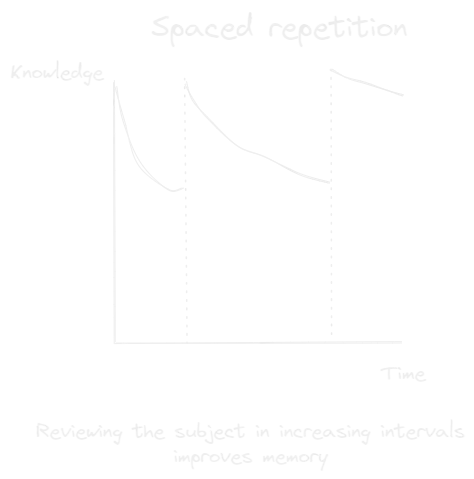
Our Human Brain is built in a way where information has to pass a certain threshold to be "saved" as knowledge. Usually this doesn't happen in the first time First attempts are inherently lower quality than iterations, so that is why what we learn is usually what we repeat. Similarly, what we see just once we forget. Therefore, in order to prevent knowledge from being deleted, we need to be constantly reminded of it.
Explanation
The Human Brain works like a computer, in which it tries to estimate what it will need in the future, and the most likely answer is what it has needed in the past We optimize by keeping the most-used close at hand. Essentially, things that are repeated are the easiest proof that this information is important and should be saved for future cases.
Why it matters
This saving mechanism also explains why when something is repeated, it becomes easier to do Repeated actions become automatic through habit formation, so this could also be true for moral acts or "to do the right/hard thing" To be moral is to act moral
Therefore, reviewing the knowledge in a regular basis can "trick our brain" to understand that this item is important since it is needed often, and therefore it will be kept long term. There is no clear mechanism on what should be the gap between study sessions, most cases say that a growing interval, like 1 day, 2 days, 5 days, a week... should be fine.
Examples
Supporters
Opposers
Open questions
Visual