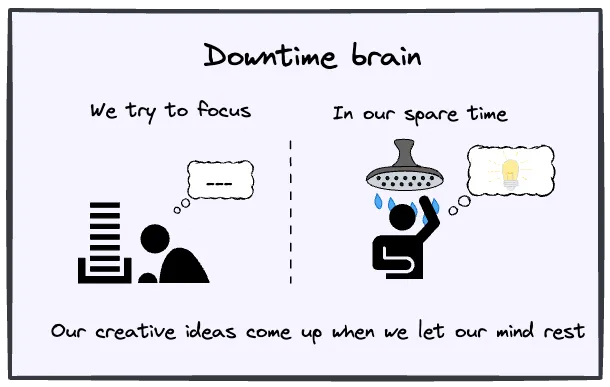
Downtime Brain
Notes
Claim
"downtime brain", aka default mode network (or DMN). However, when we relax, our thinking turns inwards, which means the DMN is activated. Solitude enables introspection and deep cognitive work.
Explanation
Expressions of that can be self reflection Introspection develops self-knowledge through internal examination, day dreaming, processing of past events, Planning is anticipating the future and preparing action accordingly for the future, social awareness, etc.
This is in contrast with the Executive Attention Network (EAN), which is our "ram", it holds information in our Full working memory reduces focus and task performance, it contains our "most frequent/obvious" responses to cases Heuristics are mental shortcuts enabling fast automatic decisions, and our general strategy.
Usually, a creative process is dependent on the connection of the two. The downtime brain creates these ideas, while the EAN contextualize it, and brings it to life.
Why it matters
This mode is critical for creative thinking and exploration of new ideas. Therefore, if you are experiencing Flow is deep immersion where performance peaks and self-awareness disappears, it is better to stop before you finish the task, such that you will continue to dive deeper into it in "downtime" mode.
Examples
For example, if you are writing a book, stop in a cliffhanger, rather than on the end of the chapter.
Supporters
This mode is critical for creative thinking and exploration of new ideas. It benefits from Unfinished tasks linger in the mind and reduce focus, where we developed unfinished ideas "in the back burner", let them simmer, and perhaps discover new solutions or variations to the idea.
Opposers
when we Focus is concentrated cognitive effort that maximizes performance on a single task, i.e commit our thinking to an external goal or action, then it is deactivated.
Open questions
Visual