Creative Destruction
Notes
Claim
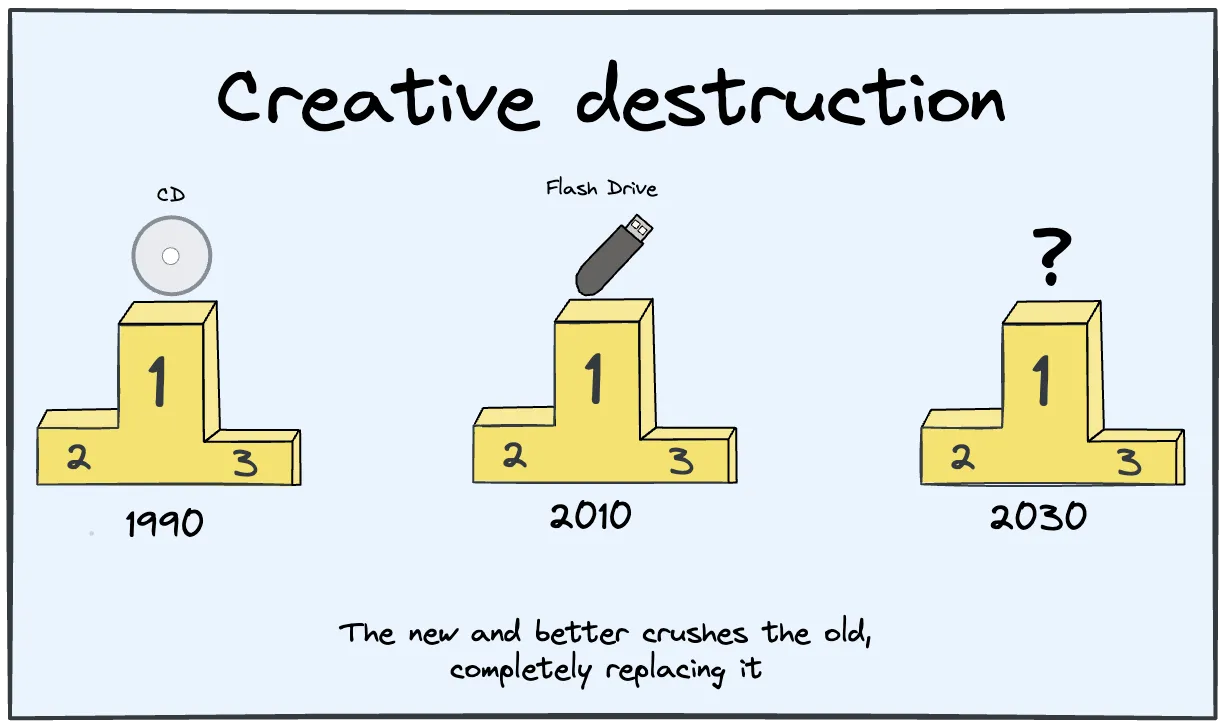
Creative destruction is the idea that progress is not a smooth linear line and small increments, but rather a cycle of destruction and reconstruction with large increments of improvements Progress and change follow non-linear trajectories with thresholds. This term is originated from economics but is also relevant for other fields.
Explanation
Creative destruction is also a synonym for natural selection, the idea that the old has to be destroyed, and is naturally destroyed, in the process of something new, better, stronger.
At the individual level, we can see such cases when a person wants or forced to change. Traumas or Challenge are moments where we feel like "do or die", either having important realizations and adapt to the situation, or we wither and fall into Depression is chronic despair from helplessness and lost meaning. It is up to us to choose how to react to a crisis. We can either surrender, let ourselves be crushed by these events, feeling Helplessness is perceiving no control over circumstances and outcomes, blaming ourselves and the world. Or, we can take matter into our own hands, embrace life as it is, hardships and all, and believe that even painful events can lead to positive things Happiness is an internal state.
Why it matters
Unfortunately, as with other cases of creative destruction, this meaningful change can't come without paying the price of the destruction of the old Learning adds new knowledge layers instead of replacing old understanding, that's why many people have epiphanies after near death situations, although the event itself didn't provide any new information, it just cleared the ground for something new to rise Symbolic fresh starts break entrenchment and enable change. Some realizations can't be taught, they have to be lived. These "lessons" are valuable, the most important lessons we can learn in our lifetimes, yet the are the hardest to learn. By training ourselves to embrace them, we can develop Some systems grow stronger through disorder, where each crisis makes us stronger, it builds us, improves us, rather than tears us down.
Therefore, both at the societal and individual level, progress requires destruction. This doesn't mean that destruction is a desired thing nor that it is easy. Some events are truly awful, and the price can sometimes be too hard to bear. However, we have to be aware of the damage we do to ourselves by trying to avoid or eliminate these hardships. By embracing Denial is choosing a false view to avoid painful truths, we at best postpone growth, and at worse we preserve a state of constant (perhaps small) suffering because we lack the courage to do what's necessary to overcome it. At the moment, overcoming has a high price compared to the low price of continued suffering, but in the long run the accumulative damage is much higher Short term bias. Even if we wanted to avoid hardships our whole lives, we would eventually be forced to face one, because Life is change, and we can't protect ourselves from it, so better to face it head on, than trying to hide from it.
Examples
Cameras used film as its source of photography for many years, and this was the truth across the industry. The rise of the digital camera was not a small gradual change but rather a "violent" destruction of the industry that has changed it from side to side.
Supporters
Deliberate Practice is the best way to develop skills treats the hard grind of practice as its own small creative destruction — you have to break the current skill level before a better one can form. Stoic stress inoculation works the same way: deliberately facing hardship in advance so the real thing finds you already rebuilt.
Opposers
Not all growth needs destruction — friction can block us as easily as adversity can build us, undercutting the idea that difficulty alone drives progress. Zooming into the self, Learning adds new knowledge layers instead of replacing old understanding pushes further: maybe nothing gets torn down at all, we just keep adding layers on top of who we already are.
Open questions
Visual