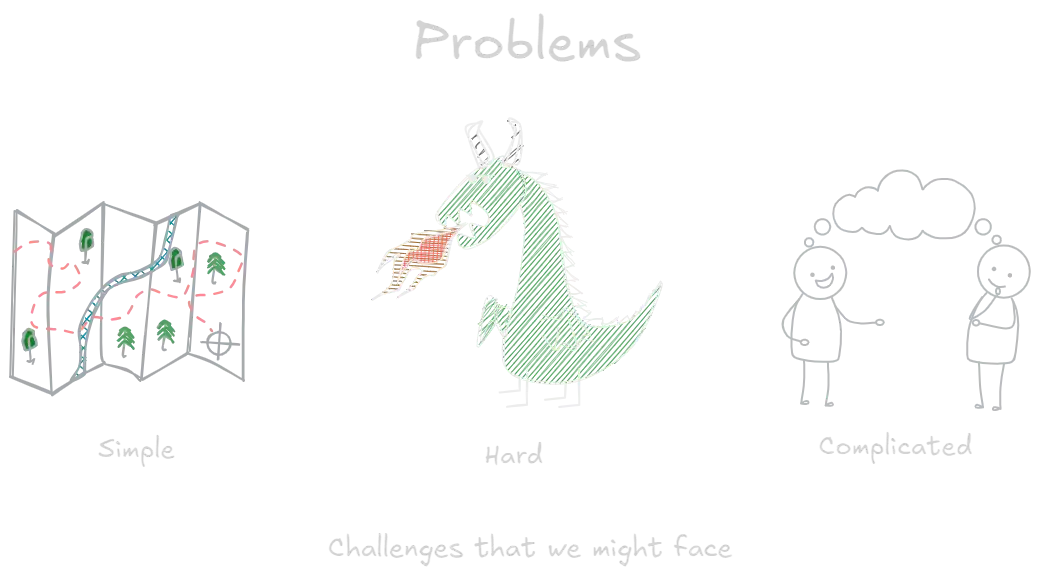
Problems
Notes
Problems are not a monolithic category. Before deciding how to solve something, it helps to understand what kind of problem you are facing.
Classifying by Complexity
Problems differ in complexity and repeatability of solution. A simple problem — like baking a cake — becomes automatic after enough repetition (Repeated actions become automatic through habit formation). A hard problem, like launching a rocket, demands expertise and coordination, but once solved it becomes reproducible. A complicated problem, like raising a child, is irreducibly variable: best practices exist, but outcomes cannot be replicated. Getting this classification wrong leads to mismatched strategies — the certainty of a hard-problem solution applied to a complicated problem produces false confidence.
How We Approach Problems
How a problem is framed determines how it gets solved. Simplify the problem before trying to solve it — when a situation seems impossible, reducing it to its tractable core is often more effective than attacking it head-on. The same logic applies interpersonally: People are not the problem — when conflict arises, seeing the other person as a partner against a shared problem rather than as the problem itself opens space for cooperation.
The Time Dimension
Problems also vary by when they are addressed. Handle problems while they are still small — because actions spread effects across time, intervening early avoids compounding consequences. Proactiveness is a form of problem management, not just a personality trait.
Visual