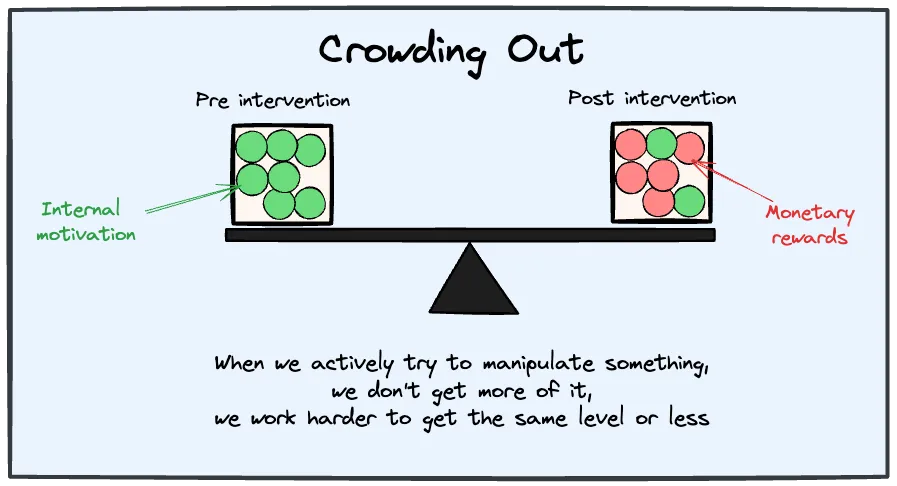
Crowding Out
Notes
Claim
Crowding out is when the increase of one activity causes a decrease in another, similar to homeostasis process.
Explanation
How to identify such cases?
- Diminishing/negative returns - we have reached a point where additional investment has little to no (or even negative) effect
- It becomes harder - we sense more Friction is resistance that blocks action and behavior adoption in what we're trying to do when previously is was easy
- Shallow replacement - we have the same (or more) quantity, but the quality has diminished Goodhart's Law
Why it matters
We should be wary of cases of crowding out because it means we work harder but we achieve the same, or less. Excessive striving produces the opposite of intended outcomes.
What to do instead:
- Identity incentives - before interfering, examine the current Incentives shape behavior by making certain actions more attractive and preferences and see which outcomes they generate.
- Go with the flow - support existing processes to increase the effectiveness, instead of trying to artificially replace it Actions spread effects across people and time beyond initial cause
- We are not econs - remember that most often people care about more than just monetary gain. Consider first social, moral and aspirational preferences first.
- Do nothing - sometimes the best we can do is nothing, we can't increase something even if we really want to. We need to have more Accepting what we cannot control is the path to peace
Examples
In economics, this is often referred to cases where the more the government invests in something, the less the private sector will invest. Similarly, if a boss tries to motivate his workers with monetary incentives, it might replace Intrinsic motivation drives action through internal alignment and passion.
Supporters
Opposers
Open questions
Visual