Mastery
Notes
Claim
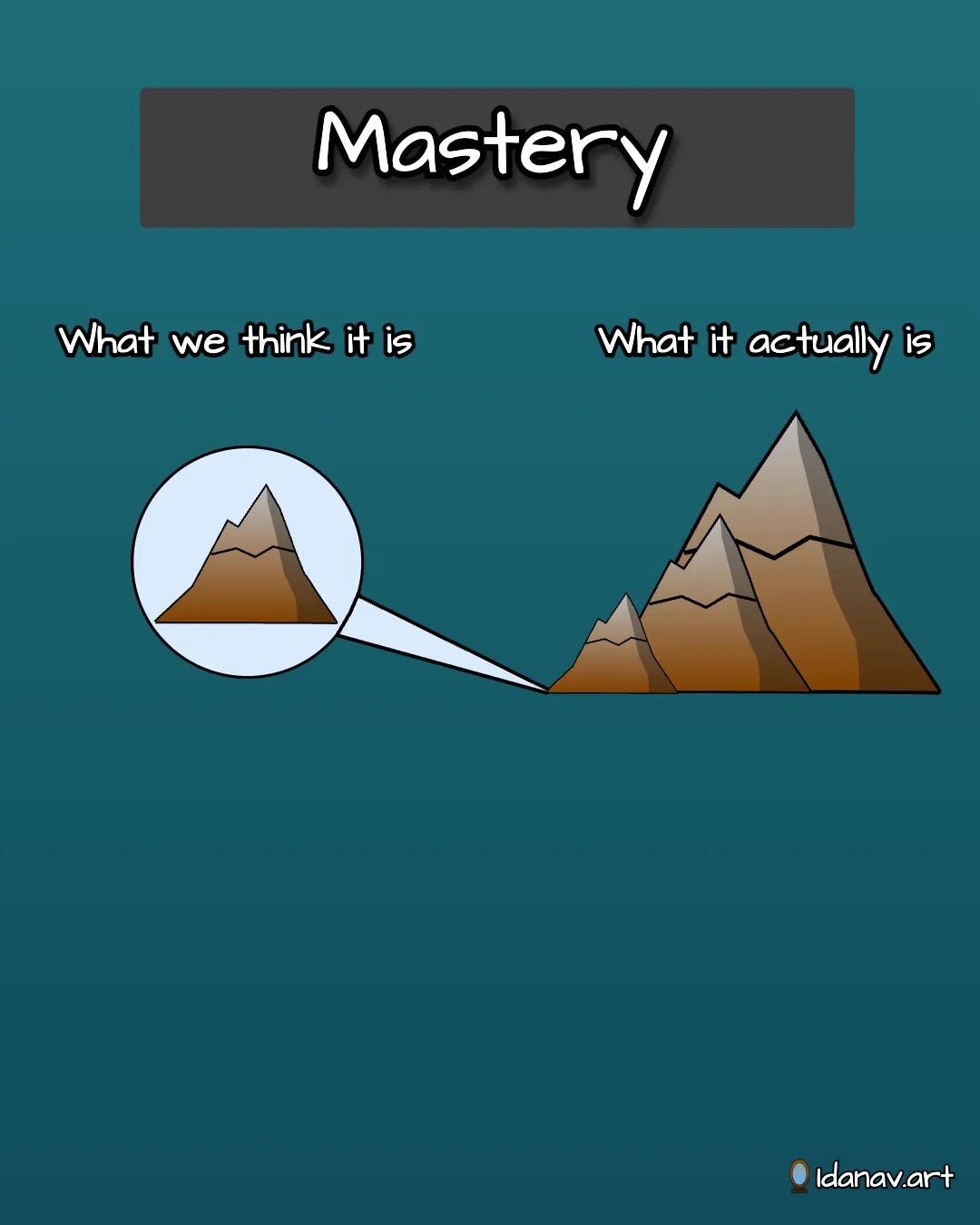
Mastery is achieved when we are really good at a certain field. It is often not clear when we achieve mastery, since not all fields are easily ranked such as chess or sports, and most fields have both verity (each person is working on different topics) and a level of personal judgment such that true ranking is not possible. For example, we can't really say who is the best artist, not on today's standards, and many cases have shown that our opinions of art change with time Complexity makes ideas harder to understand and implement.
Explanation
When trying to master a specific field, we can divide the process into different stages
- Imitation - we simply copy another person as is. We do exactly the same things as they do, without giving to much thought to the contribution or meaning of the different steps, as long as we get the desired output. Imitation internalizes others' behaviors and mental models at varying depths
- Filter - We are starting to dive into the different steps, and we are aware which are relevant and which are not to the outcome we are trying to get, and we filter accordingly. Note that on this step, the final process would be identical or shorter from the source process (that we have imitated), but it won't be different. Examining ideas rigorously before accepting them as true
- Remix - We explore various sources and combine different steps from each one to create a tailored made solution for our needs. At this stage we have lateral thinking, and we can identify what is missing in the process, what can be done differently, and we can evaluate the contribution of each step not only to the origin process they came from, but also the potential contribution in a different Actions and meaning depend on situational and environmental circumstances, with a different combination of steps alongside it. Knowledge applied across contexts enables learning generalization
- Refine - we no longer use only existing material from external sources, but we also turn inwards. We identify that each situation is unique, therefore the best fitting answer to our case would require more than just Creativity is combining existing ideas in new ways, but rather synthesizing it with our own contribution. We will create something new based on all that we have learned and tested over time Distilling separates essence from noise to simplify understanding.
Why it Matters
Examples
Supporters
While some think that mastery is a matter of talent, research shows that the only way to improve is through Deliberate Practice is the best way to develop skills. In every possible measure, Practice beats talent.
Opposers
But grinding out the same repetition isn't automatically enough — once a skill becomes automatic, we stop paying it much mind, and whatever weaknesses came along for the ride get locked in right alongside it Automation of skill makes weaknesses permanent. Mastery needs the practice to stay deliberate, not just repeated.
Open Questions
Often, there is a question whether in order to master we have to solely dedicate ourselves to the one field Specialization develops deep expertise by focusing narrowly on a domain, or whether mastery in modern times require much more branching out and mixing different fields of knowledge. Breath beats depth.
Visual