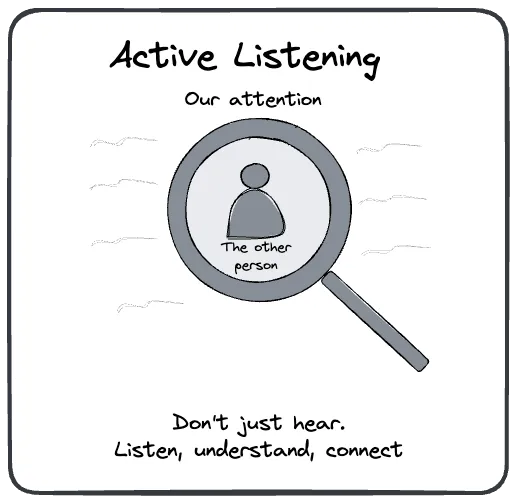
Active Listening
Notes
Claim
Active listening is as the name suggests, active. It requires a conscious effort from your part not only listen to what the other is saying, but also to try your best to understand, and react accordingly.
Explanation
Usually to truly listen, we have to quiet our mind, to focus on the other instead of ourselves, and to delay our default tendency for problem solving and Judgment adds subjective value to objective events. You are not there to prove them right, to win the argument, or even to give them advice or teach them something Avoiding rescue preserves others' opportunity to grow. They don't need any of that. What they need is your attention, an open mind and heart.
To be a good listener, first you have to be curious. Forget what you know or think you know. Avoid all Stereotypes apply mental shortcuts by inferring group traits onto individuals. Focus on the person in front of you, act as if you know nothing about them (which usually you really don't). Then, to express your understanding, try to mirror their words. By talking like them, it shows them that you understand their viewpoint, even if you don't agree with it.
Why it matters
This is a rather effortful task that demands a lot of Focus is concentrated cognitive effort that maximizes performance on a single task but the rewards are high, allowing for a much deeper conversation and connection, or simply knowing someone else better, compare to types of passive listening created by the Our attention is the product that media companies sell.
Active listening could improve the chances of achieving Empathy means understanding and acting on another's perspective, i.e creating reciprocity and Trust enables reliance on others honesty and good intent.
Examples
Supporters
Seek to understand before seeking to be understood Go first. Understand them before expecting them to understand you.
Opposers
Open questions
listening is impossible in emotional states If someone is flooded with emotion, can active listening actually get through, or does the emotion have to settle first before real understanding becomes possible?
Visual