Empiricism
Notes
Claim
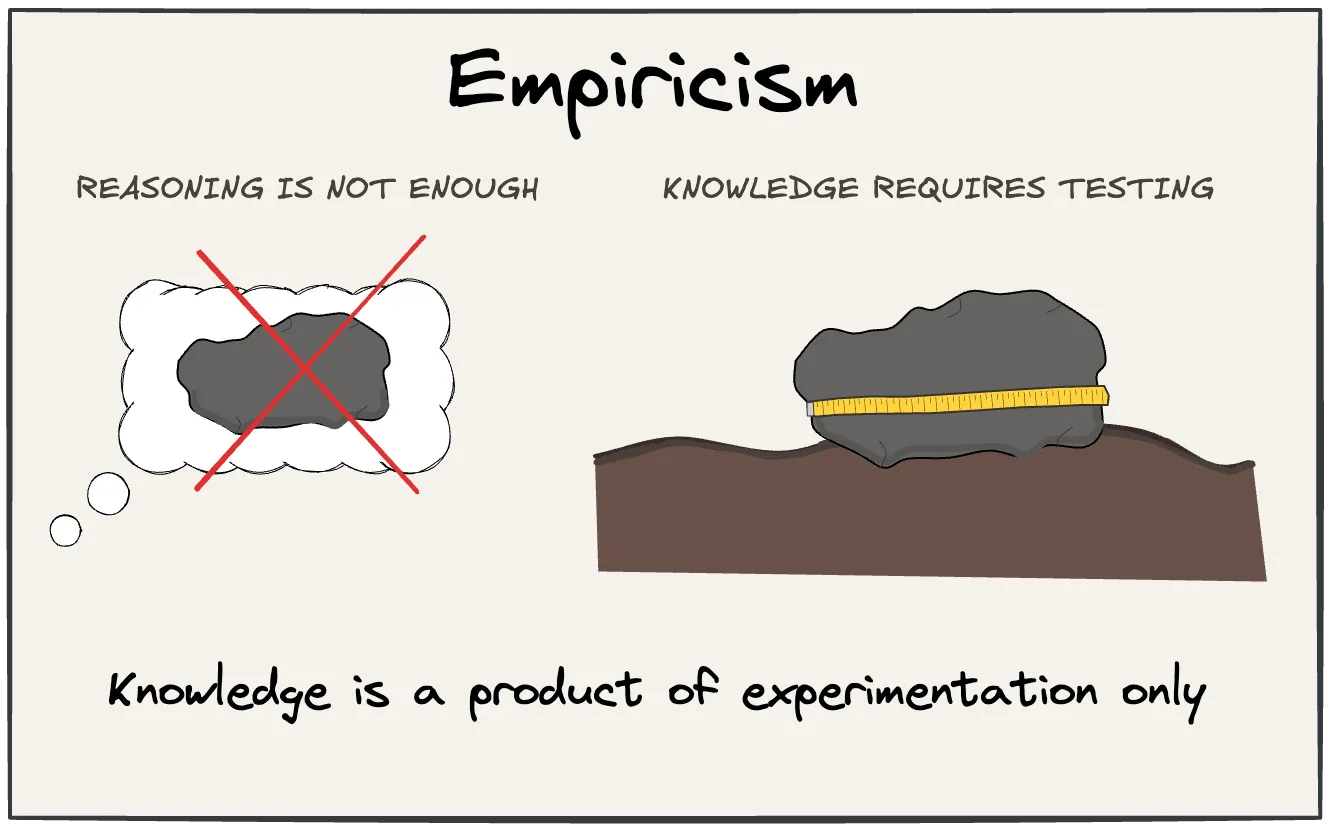
Empiricism is a metaphysical viewpoint that claims that the "truth is out there". That the only way for us to obtain some Truth about the world, about our human nature, to approve or disapprove any notion requires Experementation. The underlying assumption is that truth is an objective property of the world, that it is unrelated to human perception and it can be quantified/proven somehow. It also goes hand in hand with Everything in the world is a natural phenomenon, that every truth has a "natural" component, unlike beliefs in god or mysticism that requires an intangible source of truth.
Explanation
This is the ruling dogma led by the scientific community nowadays. To know something means to have an hypothesis, to run an experiment and test the results. This is contrary to the Truth is discoverable through reason and logic alone approach that claims that the "truth is within us", or that simply by reasoning we can collect truth about the world without the need for further evidence.
Empiricism tries to avoid Subjective perception filters how we see external reality, by distancing ourselves from personal opinions and biases using Hypothesis Testing, objective metrics and relying on a community to verify and refine what we (think we) know.
Why it matters
Examples
Supporters
Opposers
While it sounds tempting to be an empiricists, and perhaps they are right most of the time, or closest to the truth in matters of physics, chemistry and such, it is harder to claim that empiricism is as good when it comes to social science. Since much of our experience is based on personal perspective and that many social things are a Shared beliefs make constructs real and true, it is much harder to get an "absolute truth" about how people act. For example, the same test in one country won't replicate in a different one because they have different norms Truth depends on context and the observer's perspective.
Open questions
Visual