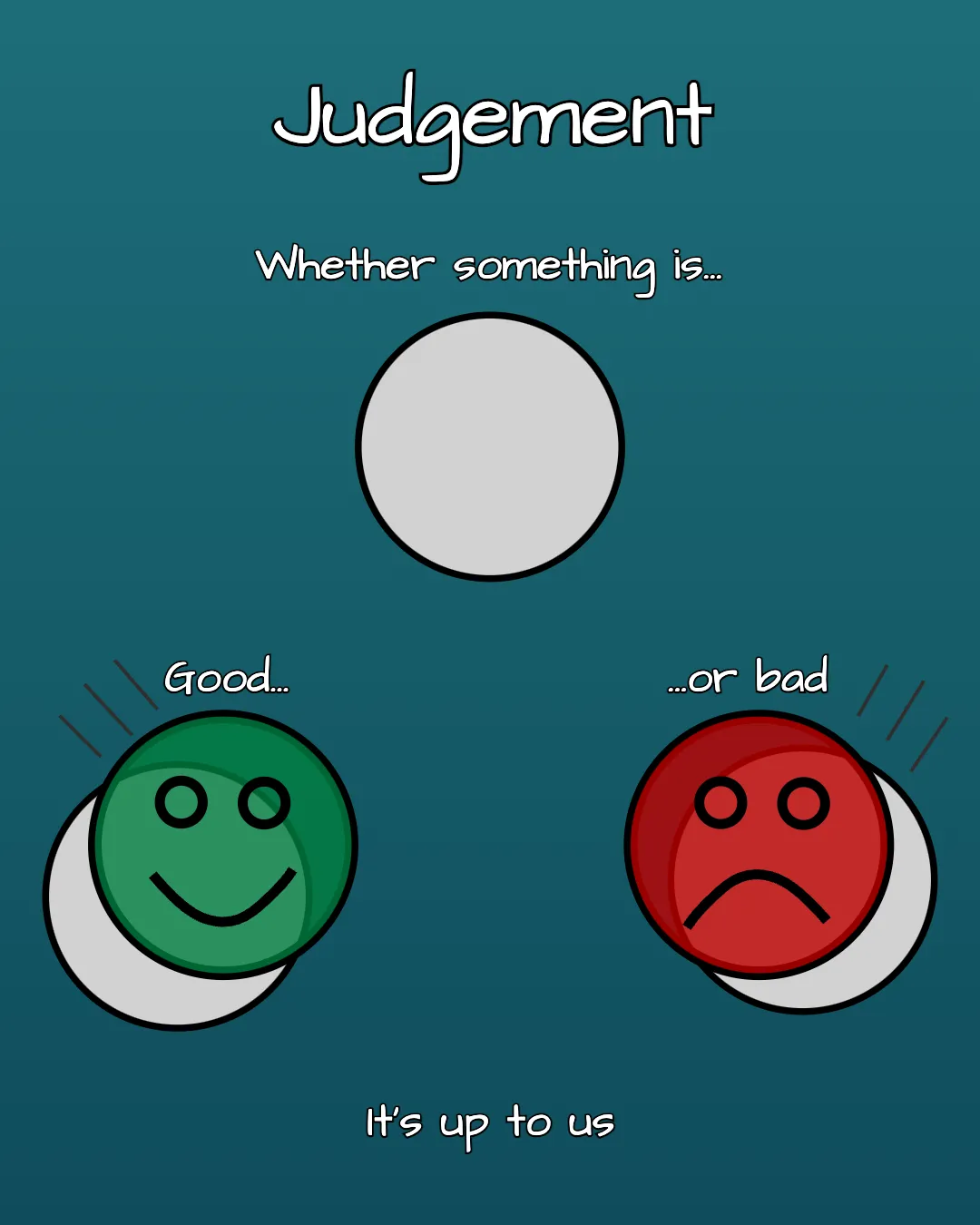
Judgment
Notes
Claim
Many believe that "good" and "bad" are concepts that are added to a situation, and not inherent in the event itself.
Explanation
It is up to us to determine how to label events, we choose the How we describe something shapes how it is perceived of an event, nothing gets registered in our mind without first being processed by us. We are the creators of our own Narratives shape perception and identity by constructing subjective reality and Subjective perception filters how we see external reality. A change in judgment doesn't always stem from a change in our knowledge about the world, sometimes the change is completely internal, from the negative event we learn something new about ourselves, without a change in context.
We are either approaching a situation with a question mark Curiosity is the joy of filling knowledge gaps or an exclamation mark, there is no room in between. We either suspend judgment and try to understand others and the situation more clearly, or we come full with assumptions about the world, detached from how things really are, trying to force our view onto the world Overestimating abilities blinds us to genuine risks.
Why it Matters
Judgment creates a tether between us and the event, sometimes preventing us from viewing it differently or noticing important information since it creates Merging actions with identity blocks growth. If something bad happened to us, the default response is to see ourselves as victims and the event as inevitable, while something good is necessarily the result of our hard work We attribute bad outcomes to luck but others' misfortunes to their faults. Only by distancing ourselves and suspending judgement we have a chance for clarity and seeing things how they are.
Similarly, judgment can create distance between us and other people. If we are quick to label someone as "bad", we are much less likely to gain Cooperation is working together toward shared mutual benefit, and will likely cause the other to distance and protect themselves from us, limiting our chances for Deep relationships require trust, listening, and empathy.
Remember that you never know all the facts, you never know what happens inside someone's mind Avoid attributing malice when ignorance or circumstance explains action, and that you are always capable of mistakes (and do so often), so be less judgmental, and more attentive.
Examples
Like missing the bus only to find later that the same bus had an accident. At first you would categorize missing the bus as a "negative" event, but afterwards you would consider yourself lucky. What had changed between those views? Not the event itself, you still missed the bus either way, but the Actions and meaning depend on situational and environmental circumstances has changed, and how we treat the event in light of that context.
Supporters
Opposers
Open Questions
Visual