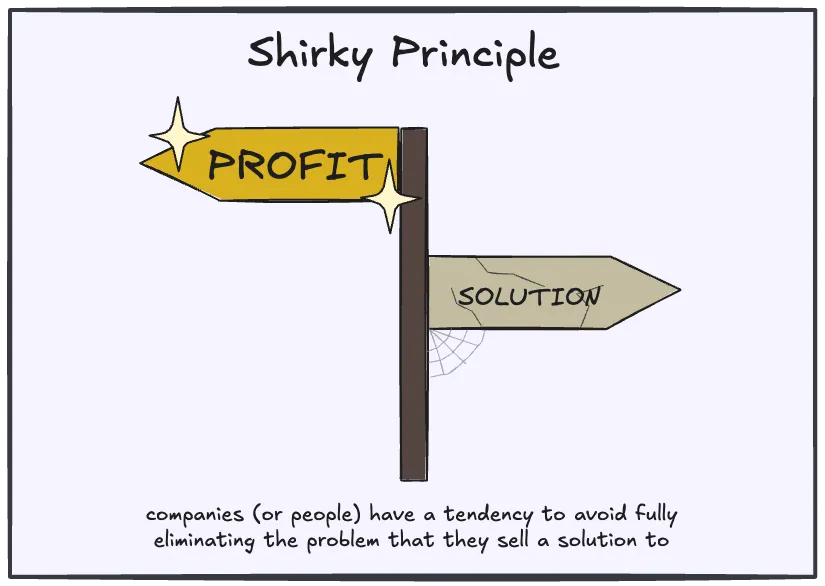
Shirky Principle
Notes
Claim
The Shirky Principle, named after writer Clay Shirky, states, "institutions will try to preserve the problem to which they are the solution." In simple terms, companies (or people) have a tendency to avoid fully eliminating the problem that they sell a solution or, lest they become obsolete. Incentives shape behavior by making certain actions more attractive
Explanation
So each institution is trying to walk the fine line between being useful (so that you would want to continue the service), but not too useful (so that it will become obsolete).
Why it Matters
Unfortunately, this means that it is hard to Trust enables reliance on others honesty and good intent those we rely on their services. The disadvantage of the Selfish incentives can produce collective prosperity is that it One activity displaces another when pursued excessively Kindness and replacing it with cold hard calculous.
Examples
For example, a language tutor wouldn't want you to be completely proficient in a language since in that situation you will no longer need him anymore.
This is also similar to cases of moral hazard. If you are not the bearer of the cost, then there is no reason for you to take a low risk (or any risk for that matter). For example, if you are financially invested in stocks and are insured in case of a loss, what prevents you from buying the most risky stocks, knowing that you can never actually lose money.
Supporters
Opposers
Open Questions
Visual