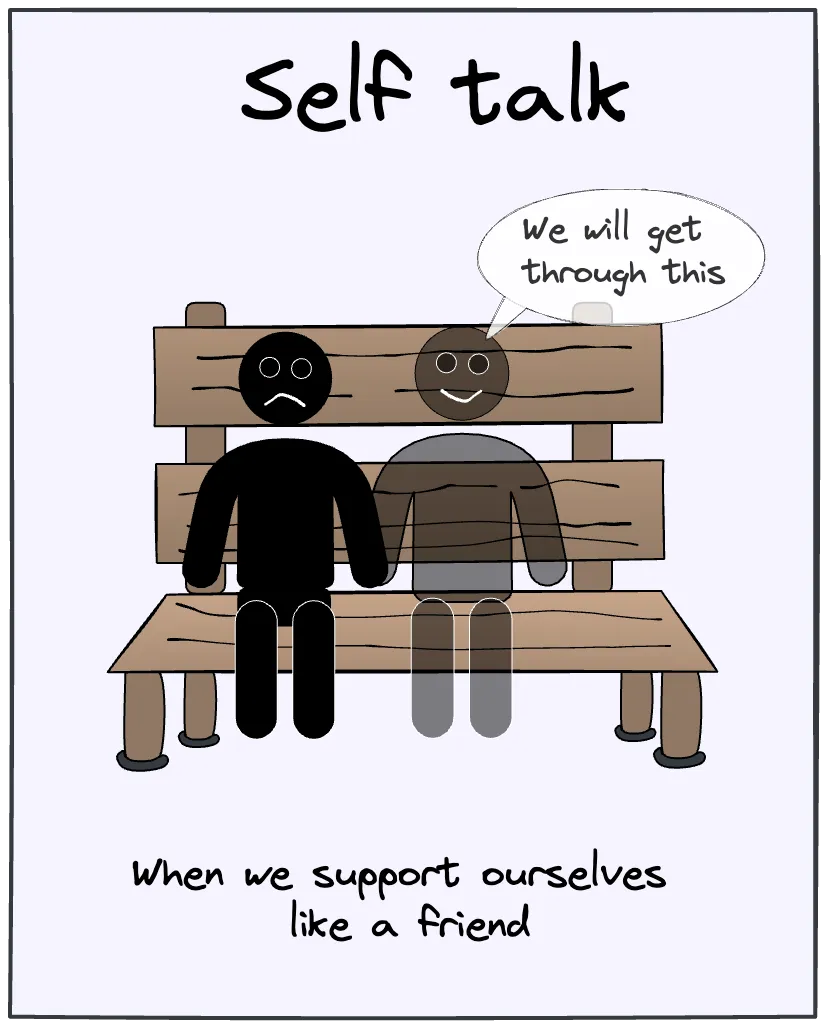
Self Talk
Notes
Claim
Usually, when we are spiraling, or unable to process the situation, it is when we either are not talking to ourselves at all, or we are too close to the situation. We say things like "why am I so stupid? Why did I do that?" Self criticism is being your own harsh judge
Explanation
In order to break the chatter and have a better Emotional resilience enables managing hardship and maintaining composure, we can implement Separating actions from identity allows growth, by looking at the situation from the outside, like a third person view, and actually talk to ourselves in third person, like to a friend Empowering language builds confidence and agency. Similarly, we can use temporal distancing, meaning looking at the situation from a "future me" point of view: what meaning or effects would these events have on my five years later? Zooming out gains perspective through mental distance
Why it matters
This can give us four benefits:
- Perspective - We can judge better the Actions and meaning depend on situational and environmental circumstances and implications of the situation, gather new viewpoint on the situation that might be healthier and more helpful.
- Wisdom - We give better advices to our friends than to ourselves. By looking at the situation from the outside, we might gain insights on how to solve the situation or what to learn from it.
- New narratives - Find a new "overarching logic" that guides us in our life, makes sense of the events and the connection between the outside world and our identity. Narratives shape perception and identity by constructing subjective reality
- Compassion - Since we are more likely to be compassionate towards others than to ourselves when we fail, talking to ourselves in third person is likely to increase Being kind to yourself strengthens resilience and growth
These aspects combined allow us to undergo a moment of Critical moments force examination of identity and belief in a healthy way without spiraling into an existential or identity crisis.
Examples
A minimal version of the technique is simply swapping your own name in for "I" — instead of "why did I do that?", ask "why did John do that?" Using your name does the same work as the outside-view framing above, forcing a third-person distance, without needing the full future-self reframe.
Supporters
A narrower, related technique is Positive self-talk builds resilience and compassion — keeping a page of meaningful quotes to draw on in the moment. It asks less of you than full perspective-taking, but it leans on the same idea: addressing yourself the way you'd address someone you care about.
Opposers
The clearest opposite is Self criticism is being your own harsh judge in its fullest form: staying in the first person, staying too close, and treating every mistake as evidence about who you are rather than what happened. That's the exact posture this note is trying to talk you out of.
Open questions
Visual