Task Batching
Notes
Claim
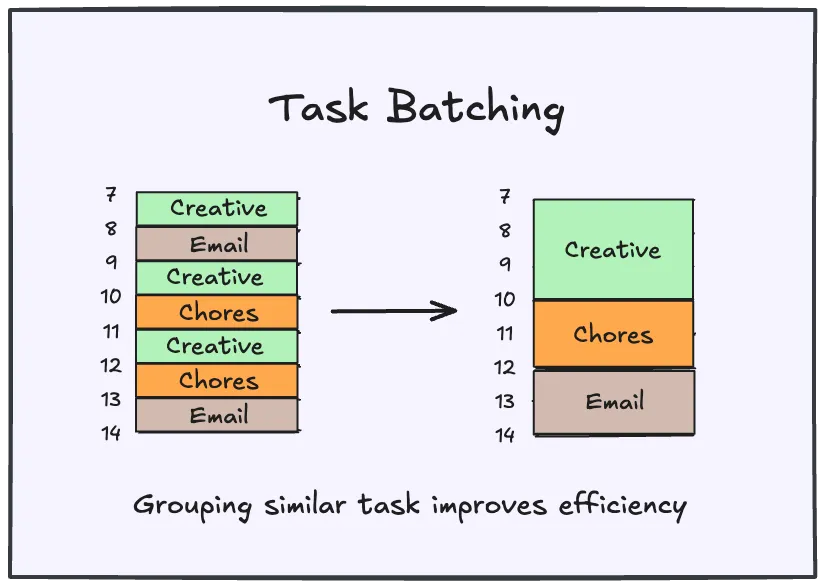
Task Batching is the idea that similar tasks should be done one after the other to avoid the price of Context Switching. By priming our mind to deal with a certain kind of task, it would be easier for us to be focused and productive on that task, instead of spreading it around our schedule, which will cause a lot of unnecessary switching.
Explanation
Some tasks are more easy to batch together. this keeps the mental content and effort the same, and reduces chances of distractions or lack of resources for the task.
the usual groups are:
- Time - which tasks should I do when (morning/evening...)
- Location - is there a logical place for these tasks? such as things that can only be done at home, remotely, etc...
- Energy - some tasks dont require energy at all, and some are very exhausting, so when you're tired, perhaps filtering to only low energy level tasks is best, or maybe it will be easier to do the high energy level tasks at the beginning of the day
- tools - does it require internet? workout gear? my computer?
- Social interaction - does this task can be done solely by me? am i reliant on others?
Why it matters
It matters because batching is what actually gets you into deep, uninterrupted work — you can't reach that state if you're re-setting up for a different kind of task every twenty minutes.
Examples
Supporters
Batching by energy is the same principle on a different axis — instead of grouping by task type, you group by how much energy each task demands, so low-energy tasks don't have to compete with high-energy ones for the same slot.
Opposers
Open questions
Visual