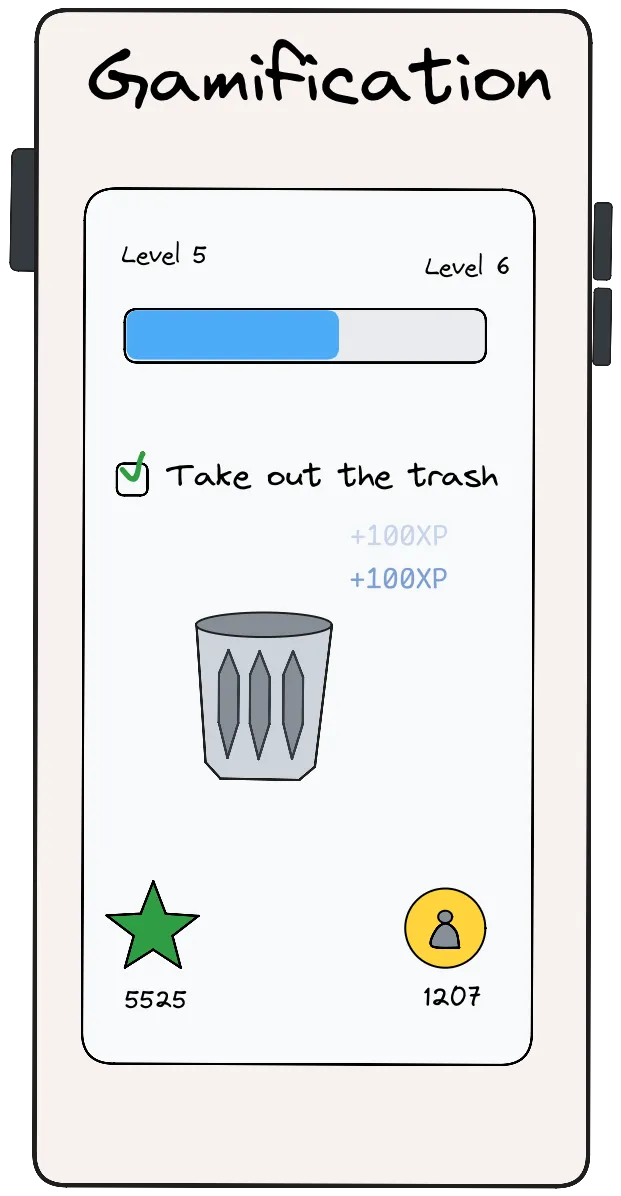
Gamification
Notes
Claim
Gamification is when we do an activity mainly because it is fun and gratifying.
Explanation
It usually involves a challenge, perhaps uncertainty, and progression (like video games). This can be either activities that we created for play, or "boring" activities that we convert to "fun" activities. The logic behind gamifying is the same as behind Bundling undesired tasks with enjoyable activities increases motivation - to add fun to our tasks to make them more approachable.
Why it matters
Examples
Tips for gamifying boring activities:
- Make it challenging - Try to add Self-imposed limits increase ability to act and creativity to the task which will turn it into an interesting Challenge. For example, try to clean the dishes with as little water as possible, or folding a laundry with only one hand.
- Keep it fresh - do things differently from time to time Flexability. Have a more curious mindset, try to find new ways of doing the same thing. Approach the task with a Openness to new ideas without expert bias
- Improve your score - Whichever task you do, try to do it better - perhaps faster, more automated, less resourced used, etc Optimization finds the efficient point balancing outputs and inputs.
Supporters
Usually games gives us a sense of Flow is deep immersion where performance peaks and self-awareness disappears, of being completely invested in what we do while our mind remains clear.
Opposers
While perhaps not a true solution to the problem, it can put Burnout is chronic exhaustion from overwhelming demands at bay.
Open questions
Visual