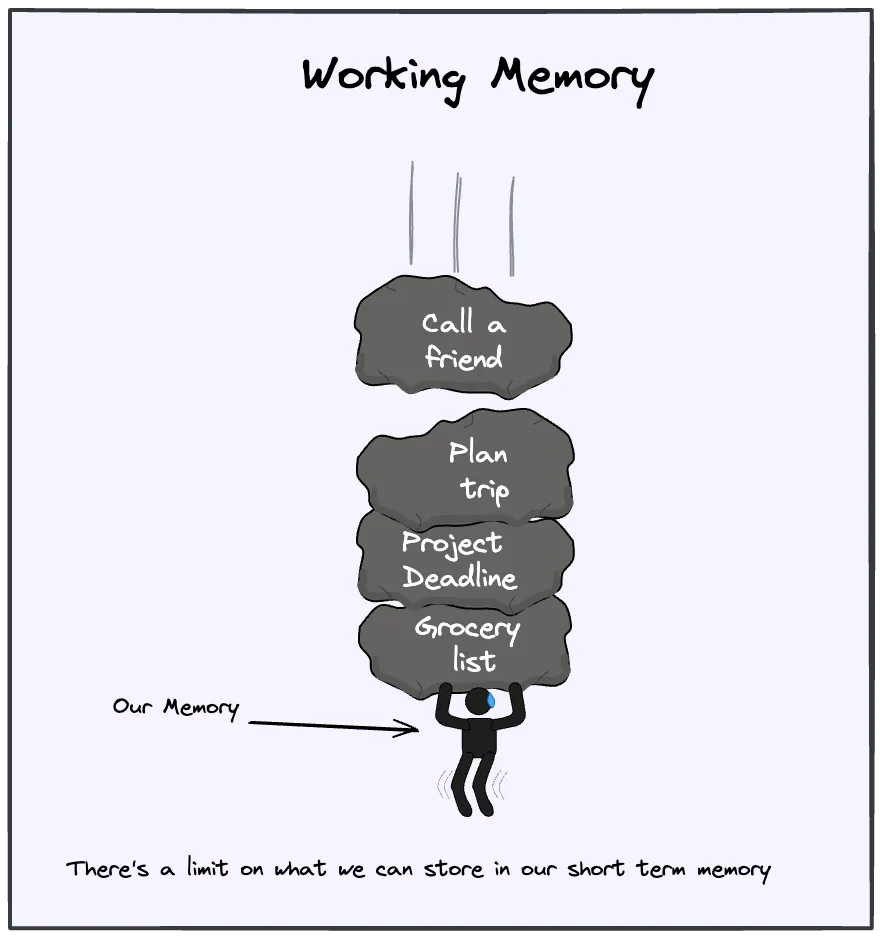
Working Memory
Notes
Claim
Working Memory is all the information that we just processed and are able to hold in our mind for the short-term. The more our working memory is full, the less Focus is concentrated cognitive effort that maximizes performance on a single task we can have.
Explanation
Imagine it like a warehouse that is constantly having things brought in and out; the less space we have, the harder it is to use it efficiently. Every system needs empty space to function
That's why we find ourselves Forgetting some things while keeping others. Usually what we keep is what our mind thinks we will use again later We optimize by keeping the most-used close at hand. Alternatively, if it's something we do repeatedly with low mental effort, it converts it into a habit so that it will take less space later Repeated actions become automatic through habit formation.
Working memory can be greatly improved by Breaking complex topics into smaller units improves learning and mastery and Mental shortcuts enable faster learning through analogies and simplification. The easier the information is to digest, the less memory it requires. Meaning that working memory is not limited by the size of what we're trying to remember, but the difficulty to do so.
Additionally, our working memory is less effective when we have less of it to spare. For unfinished tasks tend to linger, leaving less attention for other tasks.
Why it Matters
We should note that our working memory is a tool for the short term. It is a processing stage for simple tasks, and more complicated ones are transferred to the long term memory. In general, Our mind is a processor and not a warehouse, we can't expect ourselves to remember everything all the time, and especially not hold it in our conscious mind when we work on something important. It is best to outsource our memory, or parts of it, to more stable forms of memory like digital copies.
Examples
For example, remembering a random set of numbers is hard, but if we give meaning to it, like a phone number, it becomes much easier. Or, if we have a pre-built mapping of each number to a place, a person or an action, it is much easier for us to remember something tangible than random numbers Abstract information is easier to remember spatially.
Supporters
Opposers
Open Questions
Visual