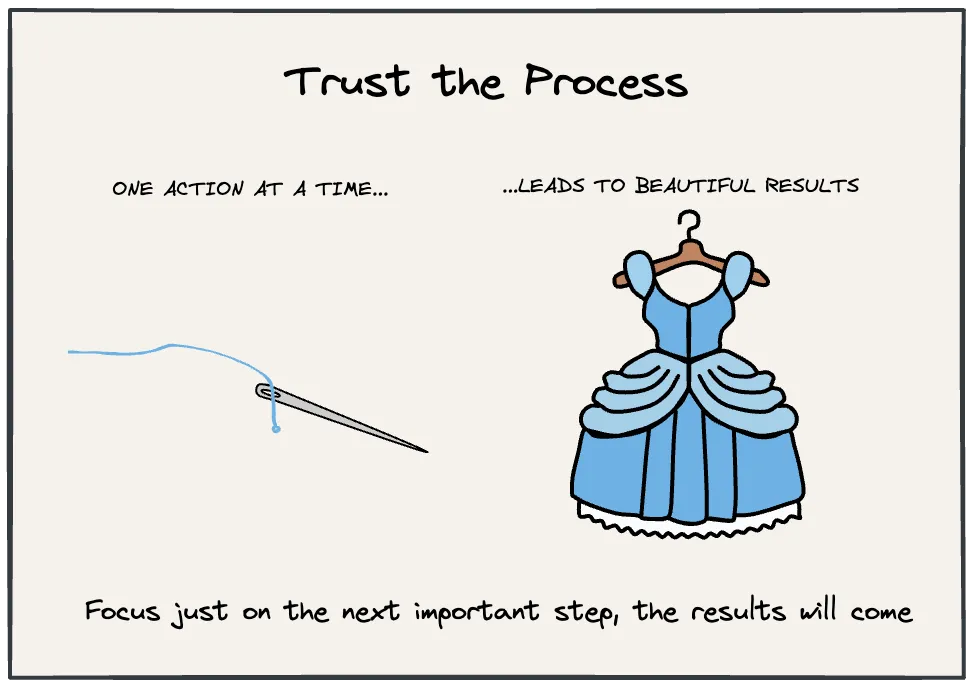
Trust the Process
Notes
Claim
Trust the process means that we should put our trust on Systems thinking reveals mechanisms enabling effective change, by understanding what are the most likely outcomes following certain actions, we should trust that sticking to those actions will produce the best results, even if some Uncertainty creates anxiety when knowledge and control are incomplete is involved within it. For example, if we want to write a book, it is enough to focus on writing half an hour every day. The final result (a finished book), would come eventually, so there's no point in worrying about it.
Explanation
The small steps we do today are what ensures us that we will reach our destination.
Habits, on the other hand, are more reliable. Mainly because a habit is an expression of our identity change starts from the inside out. Instead of "I want to lose weight", habits say "I want to become a healthy person".
Additionally, habits reframe the meaning of success from a binary yes/no to a continuum. Missing a habit for a day doesn't mean you have failed.
Furthermore, by preforming good habits, you can be certain that you make good progress daily, so that the outcomes you wish for will come naturally "by themselves". At first the results look insignificant, but over time they compound. For example, writing 15 minutes a day doesn't sound a lot if you wish to become a writer, but when it translates into 7.5 hours a month it suddenly sounds enough to do something towards your goal.
Why it matters
Focus on the process, not the outcome.
Examples
A well-known version of this: photography students were split into two groups, one told to produce as many photos as possible, the other told to produce one perfect photo. The quantity group ended up with the better photos too Practice beats perfection — repetition and process beat obsessing over a single outcome.
Supporters
We usually hold in a high regard the importance of goals, especially as our main tool for success. However, focusing solely on goals can be problematic because:
- Lack clarity - goals are usually more abstract, so it's harder to translate a goal into real life actions. For example, "I want to be successful writer" - what does that mean? When have I achieved it? (Related:: Ambiguity is the absence of clarity in values or facts)
- short sighted - what happens if you complete your goal? then you're left with nothing, and you have to start the process all over again. Usually at a price of deflation of motivation. Meaning goals can often serve as a External motivation crowds out intrinsic drive and sustainability, a reward at the end of the tunnel which leaves us empty once we reach it.
- Don't change who we are - we can say to ourselves "I want to lose weight", and we might even achieve it, but we are still the same person.
- Binary thinking - Goals are often binary, either we reached them or not, which fails to capture the complexity of human behavior and motivation.
Opposers
Not everyone agrees process beats direction — Clear direction matters more than speed of progress argues that no amount of consistency substitutes for having a clear goal to aim it at; without direction, sticking to a process just makes you very good at going nowhere.
Open questions
Visual