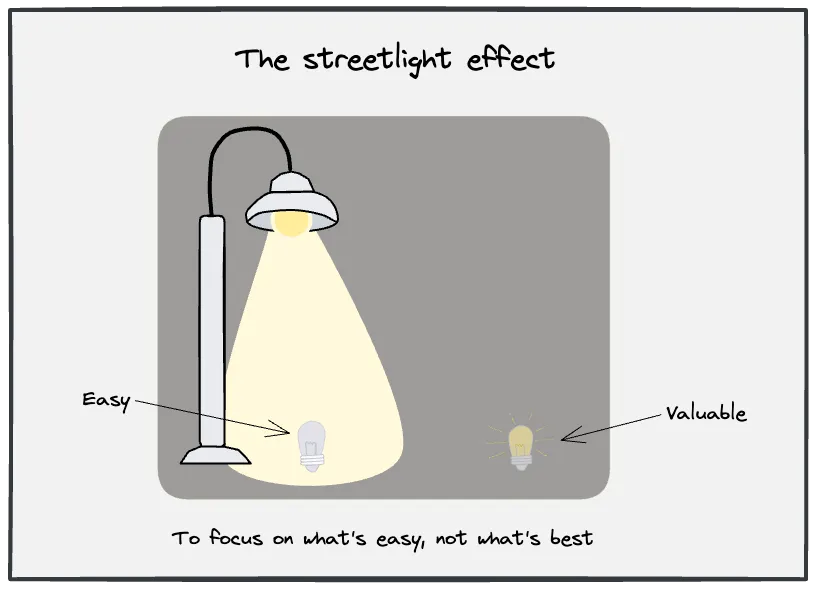
Streetlight Effect
Notes
Claim
These are cases where Distilling to essentials creates clarity and actionability fails us. This is a type of observational bias, where we focus on where it is easy for us to focus, rather than where we actually should.
Explanation
This can also be conceived as a type of We draw conclusions only from what survived where we forget to look for the Imagining alternatives sharpens our judgment. This is also similar to the Treating measurable metrics as complete truth hides importance, which focuses only on what can be measured.
This is where What matters most is often less visible than what is salient leads us astray, it captures most of our attention that we are blind to the hidden, a type of We prefer what is familiar over what is better.
Sometimes, most of what we focus on due to the streetlight effect is just a low-quality Proxy of the real thing.
Why it matters
Examples
A policeman sees a drunk man searching for something under a streetlight and asks what the drunk has lost. He says he lost his keys and they both look under the streetlight together. After a few minutes the policeman asks if he is sure he lost them here, and the drunk replies, no, and that he lost them in the park. The policeman asks why he is searching here, and the drunk replies, "this is where the light is".
Supporters
This shows up in Self-knowledge can be driven by data too — quantified-self tracking can make us mistake what's easy to log for what actually matters about ourselves.
Opposers
Not all measurement is the problem — Measurement is a prerequisite for progress points out that without measuring anything at all, we can't tell whether we're actually making progress. The failure mode isn't measuring, it's measuring only what's convenient.
Open questions
Visual