Reverse Thinking
Notes
Claim
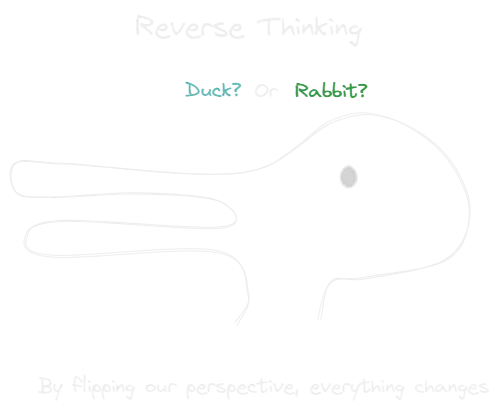
Reverse thinking is when we flip our assumptions on a situation, and see how it affects the outcome.
Explanation
For example, instead of asking ourselves "how likely are we to fail", which usually drives us towards Overestimating abilities blinds us to genuine risks, we should ask "Let's assume we failed. What caused it?". The reverse thinking frees us from issues of Ego and biases, and in this "imaginary world" where we have already failed, we can focus our discussions complexly on the risks we face Symbolic fresh starts break entrenchment and enable change.
To engage in reverse thinking is different from just "thinking more" about the subject, it's to rethink the situation entirely.
Why it matters
Rethinking should be framed as a simulation. When separating between "real world costs" and our thought experiment, we are more likely to be bold, critical and creative, discovering ideas and thoughts that were previously hidden from us.
"Flipping the script" is not easy. We are often entrenched in certain ways of thinking, which makes escaping it really hard. However, doing so can be a liberating experience. Once we reframe the situation, we feel differently, we think differently, as if we ourselves have changed.
Examples
Pre-mortem is a concrete application of this: imagining a project has already failed, then working backward to find what caused it Pre-mortem anticipates failure modes to enable preparation.
Supporters
It is similar to the Excessive striving produces the opposite of intended outcomes, that in order to get something we often need to do the opposite of what we are doing now. If something feels hard and frustrating, perhaps we are doing it wrong. Perhaps we need to Simplify the problem before trying to solve it.
Opposers
Open questions
Visual