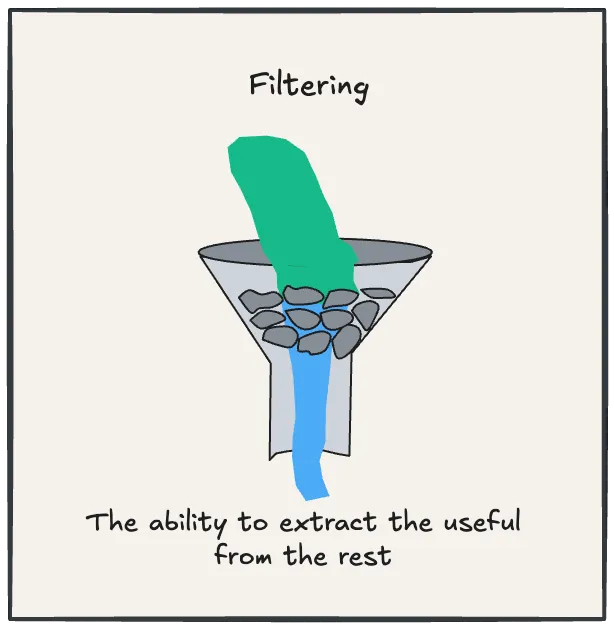
Filtering
Notes
Claim
If Distilling separates essence from noise to simplify understanding is about capturing the essence of what we consume, then filtering is about choosing what to consume in the first place.
Explanation
Filtering is hard because it's not always clear what should be the criteria that we filter by, and even if we think we do, the noise tries to disguise itself as worthy of keeping, like click-bait headings that triggers us to continue reading even if we didn't really plan to do so Our attention is the product that media companies sell. Tasks might appear as urgent or important just because they were displayed that way, although they are actually meaningless Image vs core.
Why it matters
The same logic scales beyond information intake — Boundaries reduce ambiguity by clarifying mutual expectations act as a first layer of filtering on communication and behavior itself, not just on what we read or watch.
Examples
Treating a reading list as a river rather than a bucket is one version of this Treat inputs as a flowing river, not an accumulating bucket — letting things pass through instead of trying to hoard and consume everything.
Supporters
We know that Output quality depends on input quality, so the more we are careful and mindful about what we consume, the better off we will be. In most cases, less is more, sticking with a few reliable sources is better than listing without discretion.
Opposers
If we are not careful, we might be overwhelmed with Noise obscures truth with external interference and confusion that will lead us astray.
Open questions
Visual