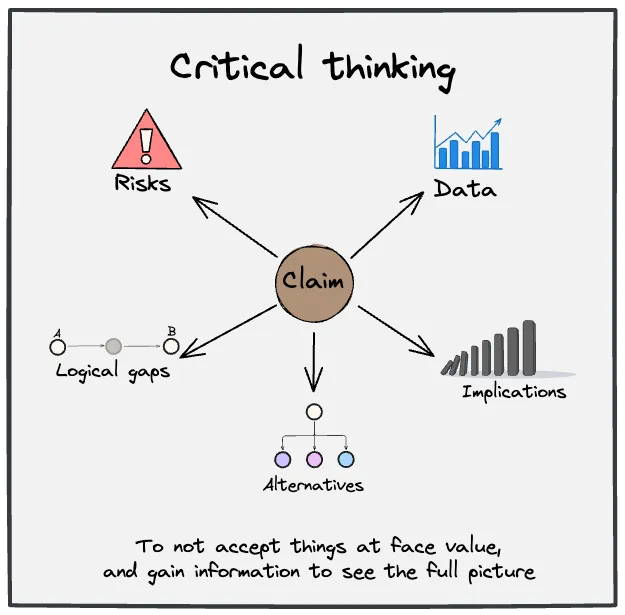
Critical Thinking
Notes
Claim
In general, critical thinking means to examine something before believing it, to search for possible ways of looking at it, different perspectives, looking for advantages and disadvantages, and validating the information we have Empirical testing not reason alone discovers truth. It is opposed to Conformation bias makes us accept confirming evidence without scrutiny where we immediately accept what we see if it supports our view.
Explanation
Critical thinking can't be done mindlessly, it requires our Focus is concentrated cognitive effort that maximizes performance on a single task and an activation of our System 2 enables deliberate analytical thinking for complex problems thinking. It is to approach a problem proactivly, to examine not only the information at hand, but also to see which information is missing Focusing on easy metrics blinds us to what matters, which other viewpoints are available Binary thinking reduces complexity to false dichotomies, whether it is presented in a biased way How we describe something shapes how it is perceived, etc.
Why it matters
Critical thinking can also lead to Ideation generates ideas through exploratory thinking freed from constraints. By refuting and analyzing the current situation, we might come up with new and better ways of doing or thinking about something.
Examples
Supporters
To be a skeptic means to constantly be Curiosity is the joy of filling knowledge gaps, to never accept things automatically, rather try to understand them. To approach a question with Humility is acknowledging limits of knowledge and fallibility that we might not know the answer, and that we need time and resources to find the best one. It would often require us to reexamine what we think we know.
Opposers
Overconfidence is the natural enemy of this — when we're already sure we know the answer, we stop asking the questions skepticism requires Overestimating abilities blinds us to genuine risks.
Open questions
Visual