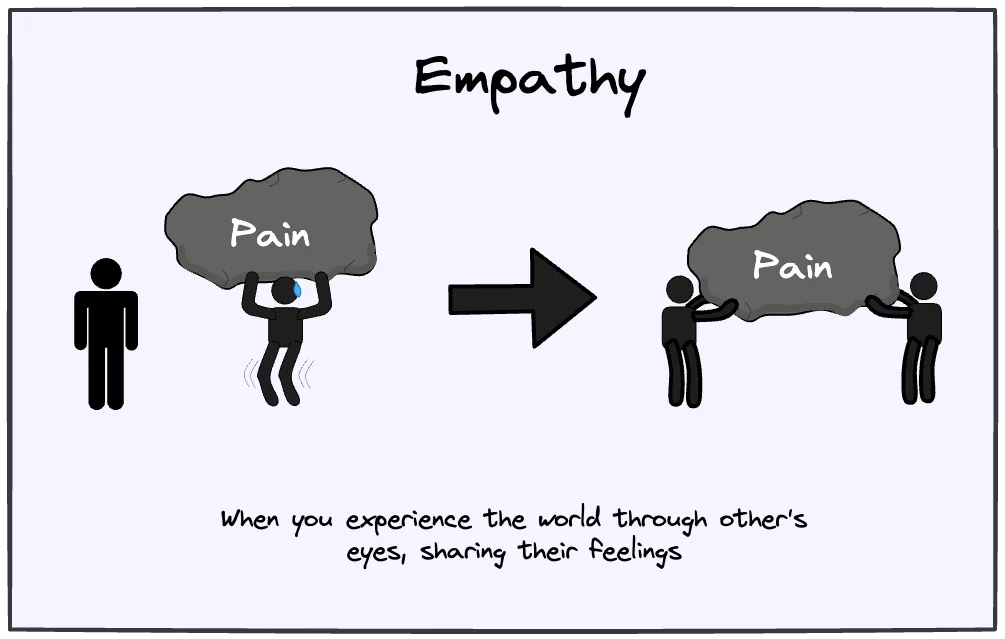
Empathy
Notes
Claim
Empathy is a conscious act of connecting deeply with a specific individual: our ability to place ourselves in their shoes, to identify with their pain, their struggles, and preferences. This requires us to leave our own Subjective perception filters how we see external reality and step into theirs. Therefore, to be empathic is to see the world through their eyes and trying to make it better based on their definition of good, not yours. Although, understanding them doesn't mean that we agree with them. Empathy is more than just our ability to mirror other people, because empathy goes beyond the external layer of displayed emotions into the deep layer of reasons and feelings. It is also not emotional contagion, where a feeling, often a negative one, spreads between people subconsciously and without any effort to understand it — empathy is chosen and directed at someone, contagion just happens.
Explanation
The fact that people are able to be empathetic perhaps it's a sign that we humans are social being. It could be argued that the reason that People are inherently good is because our tendency to empathize causes us to feel pain, so we wish to free ourselves of that pain by solving their problem. However, seeing and sensing too much pain, trying to carry the weight of the world on our shoulders might lead to Indifference can be protective or harmful depending on its source as an act of self preservation, blocking empathy from occurring.
Why it matters
At the individual level, empathy is a great way to connect with someone, to bring you closer to a state of Oneness, while negating feelings of Loneliness is the painful state of feeling disconnected from others because we are finally seen and heard. Empathy also is the first step towards having our feelings validated, because understanding is a necessary step to acceptance. When we empathize with another, we are much more likely to be Altruistic towards them.
Examples
Direct exposure builds empathy and awareness — spending real time with someone whose life differs from yours does more for empathy than just hearing about it secondhand.
Supporters
Emotional understanding precedes intellectual understanding — we often feel what someone is going through before we can explain it, which is part of why empathy so often leads understanding rather than following it.
Opposers
At the social level, it can be argued that empathy promotes Cooperation is working together toward shared mutual benefit, but the question is towards whom? Since it is easier to emphasize we people who are similar to us, it might also support a Group membership biases perception and shapes intergroup hostility mentality, promoting cooperation with the in group, while distancing ourselves from the out group. This goes against the idea of Design society as if you don't know your place in it, that decisions should be made in an impartial way. If we are empathic, it is like we are choosing who to be biased towards.
It also runs into Effective helping requires detachment from the other's pain — getting swept up in someone's pain can cloud the judgment needed to actually help them, a different failure mode than the bias problem above.
Open questions
Visual