Designing our physical space makes desired behavior easier and unwanted behavior harder
Notes
Claim
Environmental design is arranging the physical spaces we live and work in so that the behavior we want is easy and the behavior we don't want is hard. It can be soft, like moving things out of sight or reach, or hard, like removing them from the space altogether.
Explanation
Our surroundings decide a lot of what we do before we decide anything. We can distinguish between two forms of shaping them. The soft form makes a behavior harder or easier to reach, without removing it, like putting the cookies in the topmost drawer. The hard form is high effort and eliminates it from the space, like not buying the cookies in the first place.
Environmental design is often reliant on using Cues to our advantage, we create an environment which makes it easier to send the signals that will trigger the desired behavior. Sometimes the environment is so full of negative cues that we need a Symbolic fresh starts break entrenchment and enable change, usually by changing the environment itself rather than it's components so that it could be manipulated in the first place.
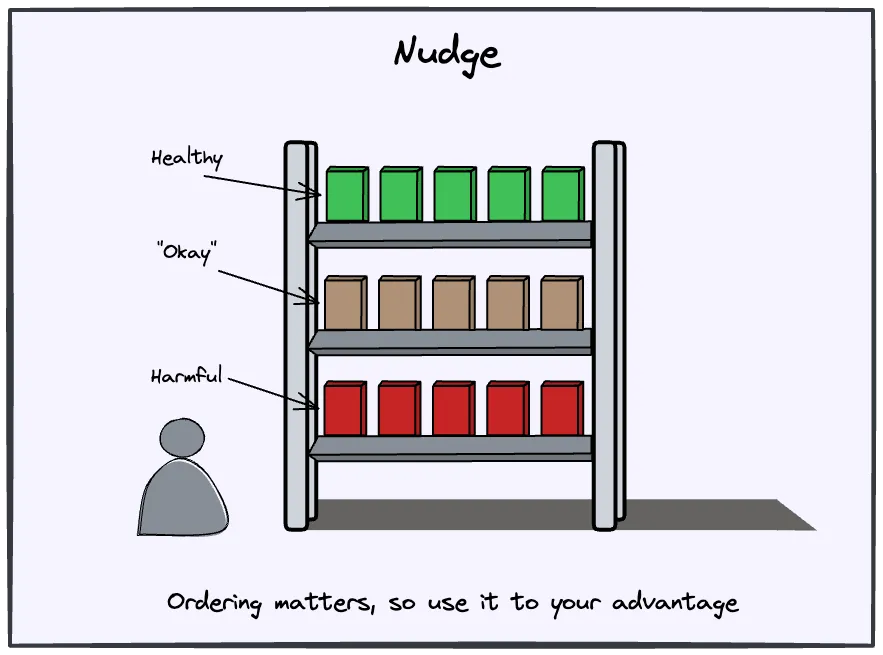
This is separate from choice architecture, which works on how the options of a decision are presented and doesn't require any physical space, like the default on a form.
Why it matters
The advantage of designing the space is that it only has to be done once, one time where we make an effort to change the environment, and then it will come naturally to us, instead of brute forcing using our willpower each time One-time effort investment yields future benefits.
Thinking through the lens of environmental design means expanding the concept of the self to include our environment as well as a significant part of determining our actions, which requires to take Ownership means taking active responsibility and control of your environment not just on "ourselves" as a person with a body, but also on our environment in which we live in. Once our environment matches our values, we can finally reach a state of harmony
Examples
- Cookies - putting them in the topmost drawer is a soft change, not buying them at all is a hard one
Common phenomena related to environmental design:
- Nutrition - this is a classic case of limiting distractions instead of trying to fight time. Usually nutrition is all about making healthy choices easier to make, and reducing encounters with unhealthy food Nutrition
- Distractions - often our goal with environmental design is to limit Distractions as much as possible, so that we will avoid the temptations all together without ever facing them
Supporters
Nothing is forbidden, but the fact that some things are easier to reach than others Friction is resistance that blocks action and behavior adoption makes them the more likely choice. Systems thinking reveals mechanisms enabling effective change
Opposers
Open questions
Visual