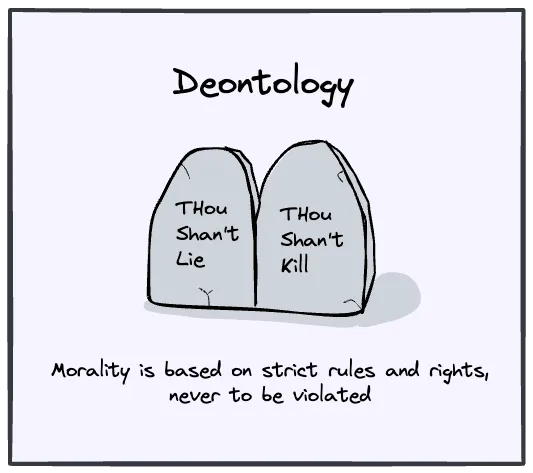
Deontology
Notes
Claim
Deontology is an ethical framework built on duties and rights. This is a top-down approach for ethics, dictating that certain actions are always good / wrong. Binary thinking reduces complexity to false dichotomies
Explanation
Deontology is different from Maximizing pleasure and minimizing suffering defines moral action that evaluates the moral worth of an action based on it's results. Deontology on the other hand gives more importance to the Good action requires intention aligned with values behind it. It's one of a few competing attempts to reduce morality to a single rule, alongside utilitarianism and virtue ethics, which locates goodness in a person's character rather than in their duties or their outcomes.
Why it matters
Grounding morality in duties and rights, rather than results, means those rights don't evaporate the moment the math stops favoring you. All moral agents are inherently entitled to basic rights regardless of utility or merit makes a similar case for why some protections should hold regardless of merit or usefulness — deontology gives that intuition its clearest philosophical backing.
Examples
For example, lying is always bad because it goes against the idea of treating others as humans who have the same rights as yourself. Similarly, breaking into someone's home or attacking someone is also always wrong. Good action requires intention aligned with values
Supporters
This is essentially Kant's test: Act only by rules that could apply universally — an action is only moral if the rule behind it could consistently apply to everyone, not just to you in this one instance.
Opposers
As with utilitarianism, the attempt to reduce morality into a simplistic, rational process has several flaws:
- It disregards Actions and meaning depend on situational and environmental circumstances - every action is either universally moral or immoral, there is no room for deciding what's right in the given moment based on the specific circumstances of that experience
- it lacks Diversity of perspectives strengthens decision-making and understanding - it is as if we can all come to the same moral agreement based on rationality alone. It doesn't accept more than a single worldview, i.e it is as if there is only one correct moral answer.
- It ignores our emotions - deontology is based on duties derived by reason. It treats our emotions as things that only lead us astray, even though Morality is both rational and emotional
Open questions
What if an axe murderer comes to your house and asks where are your kids? Shouldn't it be okay to lie then? What about killing out of self defense? The main fault of deontology is that those absolute rules usually have exceptions that deontology just can't cover.
Visual