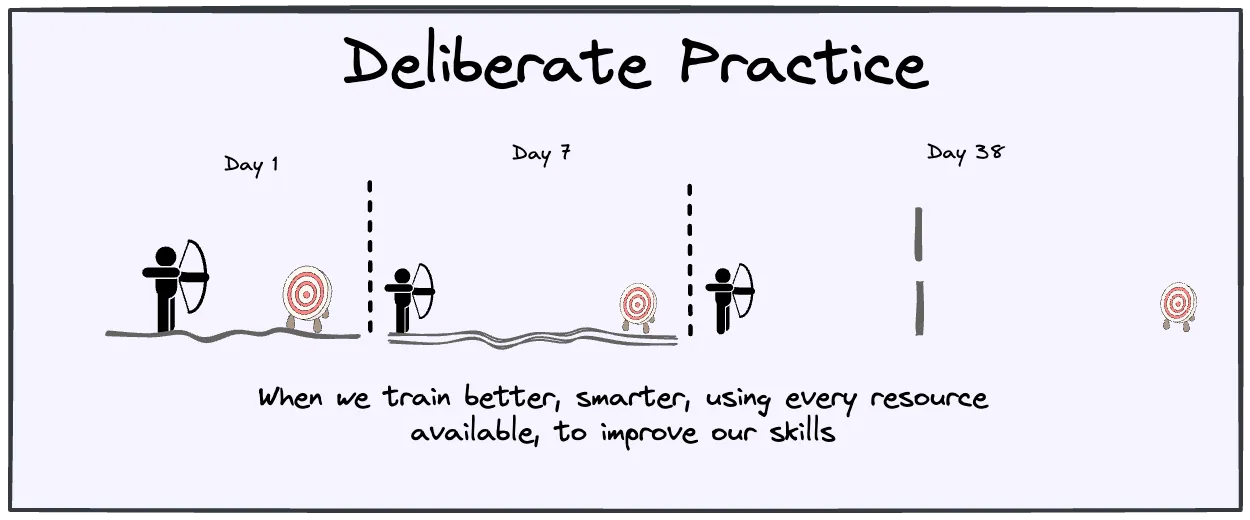
Deliberate Practice
Notes
Claim
Deliberate Practice is the best way to learn, to gain new skills and to grow.
Explanation
Deliberate practice as the name suggests isn't easy, because Learning should be hard. It is through challenges that we are able to grow Obstacles as stepping stones, raw talent isn't enough. It won't be fun, it will be hard, and it will require Grit enables persisting through struggle and challenge, but this is the only way to achieve Mastery requires deliberate practice and hard work, not innate talent. Deciding to do a delibarate practice is not something you do on a whim. Make sure you have sufficient Intrinsic motivation drives action through internal alignment and passion for it otherwise you will experience Burnout is chronic exhaustion from overwhelming demands or you will quit.
Common components of deliberate practice:
- Feedback - without knowing what you did right and wrong it's harder to improve. Feedback is information that enables behavioral improvement
- Challenge - a good practice is one which tries to stretch your limits. not too hard, but not too easy Challenge
- Goal - you must have a goal you're trying to reach, something concrete and easy to measure Clarity is achieved through definition and presentation.
- Technique - improving is usually not by trying harder, but by trying smarter. Find a method that works for you. Systems thinking reveals mechanisms enabling effective change
- Mentor - it is rare that one can do a deliberate practice alone. When we practice our talent, we need to have our complete attention devoted to it, to experience Flow is deep immersion where performance peaks and self-awareness disappears. That's why we need an external observer (and an expert's) that can point us towards the right direction Mentors provide expert guidance and feedback for skill development .
Why it matters
Examples
Supporters
Opposers
Open questions
Visual