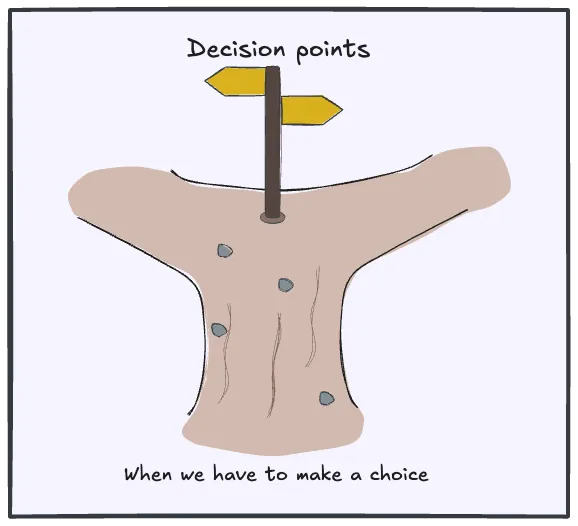
Decision Points
Notes
Claim
Decision points (or trip wires) are moments when we are forced to stop and reevaluate our decision, or take a new one.
Explanation
On the one hand, decision points are a form of Friction is resistance that blocks action and behavior adoption, they interrupt the process and force us to make a conscious choice. This also taps our limited willpower. On the other hand, it can help us avoid Past choices constrain future options and behavior and Herd Mentality by making us think about our actions.
Why it matters
The problem with decision points, as in other cases, that the threshold we put in place is always arbitrary because it converts a complex reality to a binary case.
Examples
Tripwire methods (planned decision points):
- Deadlines - this forces us to justify or review our decision by a certain date, like a falsification condition - for example, if we don't reach 1m customers by x... Deadlines force action by adding consequences
- Partition - we divide our resources into "buckets", and question whether to proceed between buckets. For example, instead of using the entire budget for a project only to discover it takes more money, we will divide it into 20% buckets, and will review whether to stop the project after each 20%. mental accounting
- Patterns - something unexpected happens that requires rethinking our decision. So if x happens, let's discuss.
Supporters
Opposers
Rituals bypass overthinking by replacing decisions with steps — where decision points deliberately interrupt to force a choice, rituals deliberately remove the choice to preserve mental energy.
Open questions
Visual