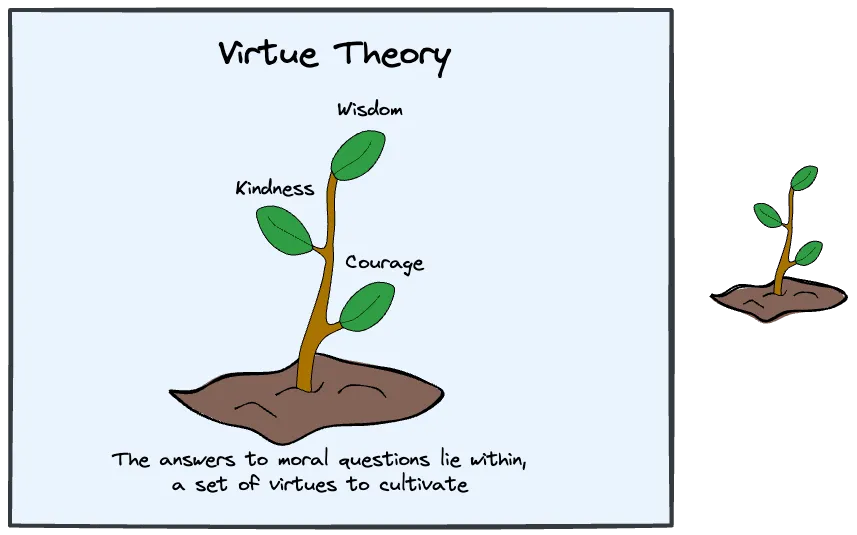
Virtue Theory
Notes
Claim
As opposed to Deontology treats morality as duties and rights that transcend consequences and Maximizing pleasure and minimizing suffering defines moral action, according to virtue theory, a good moral person is a person who possesses and cultivates within them the right virtues.
Explanation
Virtues are both values and rules for behavior, therefore they serve as the best of both worlds. They include some of the rule based reasoning of deontology, while also caring for the final outcome like utilitarianism. While it does share the strengths of each view, since it does not focus solely on one thing it can avoid most of its flaws.
Instead, virtue theory says that moral actions have to come from a virtuous person. Morality is not a textbook, but rather a never ending mission to become a better person Transcendence is the act of continuously becoming a better self, to have unbiased reasons, to have an objective perception on reality Judgment adds subjective value to objective events. To be more kind, couragous, flexible and moderate.
Why it matters
Virtue theory is perhaps the least satisfying moral code compared to the others, since you don't get an absolute predefined answer on what to do in each case. It doesn't make our life easy, but it doesn't hide behind simple solutions that fail in real life. Morality is a complex matter because life is complex. We can never know the answer in advance; it relies on the context, on us, the people involved, and so many other small details that could never be translated to simple wellbeing numbers, or be captured in general rules.
Perhaps it's an unreachable goal, but it is the one that will put us closest to being a good person, and making good moral choices.
Examples
In deontology, the main issue is the lack of flexibility—everything is absolute (lying is always wrong, etc.). But what if a murderer comes to your house and asks where your kids are? As mentioned in Greek philosophy, to make the right decision you need Actions and meaning depend on situational and environmental circumstances. You need to think about what it is you are truly doing by performing this action in this very case.
For example, lying is bad, but not if it helps prevent murder, which is clearly the worse outcome.
Similarly, my main issue with utilitarianism is that you can't "trust it". Sure, it almost guarantees the best outcome in terms of overall happiness, but shouldn't that mean that we should butcher people in the street if their organs can save more people? The lack of reasons behind the action can sometimes cause our support for utilitarianism to be inconsistent.
Additionally, utilitarianism has an easier case in a world where all the outcomes are predefined and known, but what happens in cases of uncertainty? The math could easily fail since even knowing the probability for each of the outcomes could be beyond calculation. In that case, we need reasons and the right motives more than ever.
There is temptation in Distilling to essentials creates clarity and actionability, because we usually tend to shy away from Ambiguity is the absence of clarity in values or facts. Simple moral solutions such as "never lie", or a wellbeing calculation are tempting because we don't have to make an effort and think for ourselves what we should do. The answer is clear and we should just follow the rules. Instead, getting advice such as "be courageous, but not too much" sounds frustrating and unhelpful. How does that help us?
Supporters
This tracks with Happiness is to be virtuous — living a good life is understood as having a good, morally consistent character, not just an outcome or a rule followed.
Opposers
Open questions
Visual