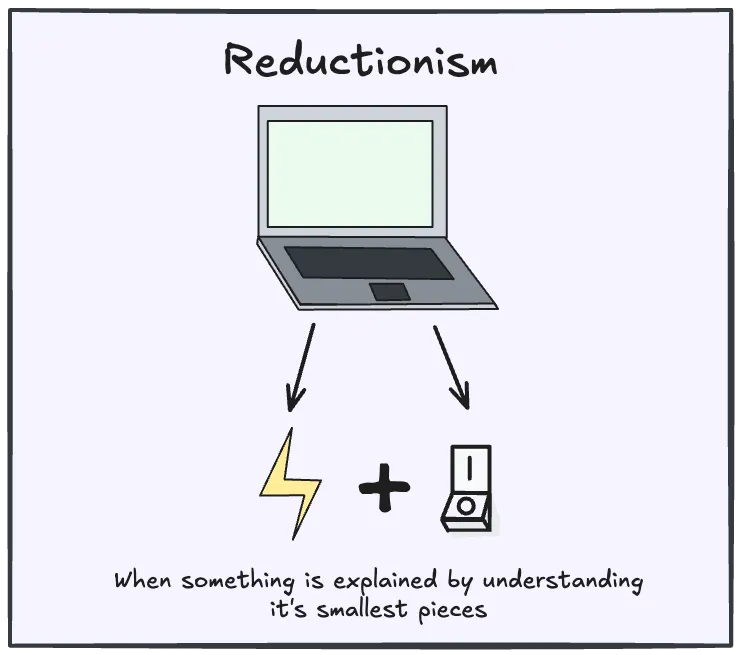
Reductionism
Notes
Claim
According to reductionism, many of life's properties, can be understood, explained, or better viewed as when we distill it to it's core.
Explanation
For example, questions about meaning and happiness seems too big to tackle, but perhaps a good enough explanation for our reasons for action could be explained through the lens of Utility quantifies measurable benefits and guides rational decisions, to reduce the question of happiness to a simple pain/pleasure framework.
Why it matters
This is also why Breaking complex topics into smaller units improves learning and mastery — once you know a thing's core parts, you can learn and master it piece by piece instead of facing the whole undifferentiated mass at once.
Examples
A clear case of this in ethics is utilitarianism, which reduces the sprawling question of what makes an action moral down to a single measurable quantity: net pleasure minus pain.
Supporters
Rather than believe that truth is an emergent property, it means to believe that it is in the details. That to simplify problems into small manageable units is not only better it's also more correct Simplify the problem before trying to solve it. This is essentially the atomist stance: Understanding requires breaking things to their smallest parts argues a system's features are just its smallest components, nothing hidden beyond them.
Opposers
The whole is greater than its parts — some properties are emergent, arising from the interactions between components rather than the components themselves, so breaking something down can lose exactly what makes it what it is.
Open questions
Visual