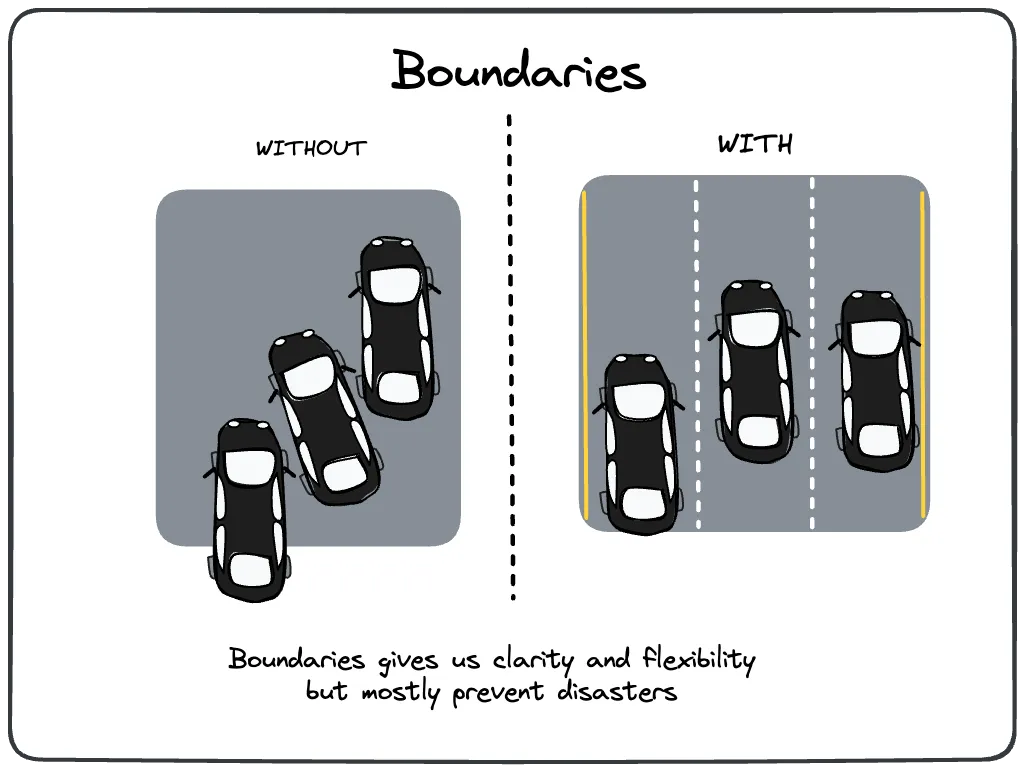
Boundaries
Notes
Claim
Boundaries are our linguistic skin. It is our first layer of filtering out incoming stimulus. By setting boundaries, we limit the kind of communication and behavior that is expected to us and from us.
Explanation
Since We can't read minds, setting boundaries is actually a way to strengthen Deep relationships require trust, listening, and empathy because we remove the Ambiguity is the absence of clarity in values or facts and increase the Clarity is achieved through definition and presentation of what is expected from each other. We have less of a guessing game, and more chances to act the way that the other wants to, improving their well being and ours. It's a Win-win outcomes align interests and benefit all parties, where both sides are better off.
Why it matters
Many times, when we find ourselves frustrated or angry when communicating with others, whether it is anger towards others or ourselves, it is usually due to a lack of boundary. If only we would have mentioned our preferences, for example how something makes us feel which is why we don't want it to happen again, or what is our preferred method/time to communicate about certain issues. Boundaries force us to be more transparent.
Sometimes, we believe we don't need boundaries because we believe that they other side has the same preferences as us, which usually leads to Disappointment is the gap between expectations and reality. We must remember that everyone has it's own perspective.
Examples
Supporters
Opposers
Open questions
Visual