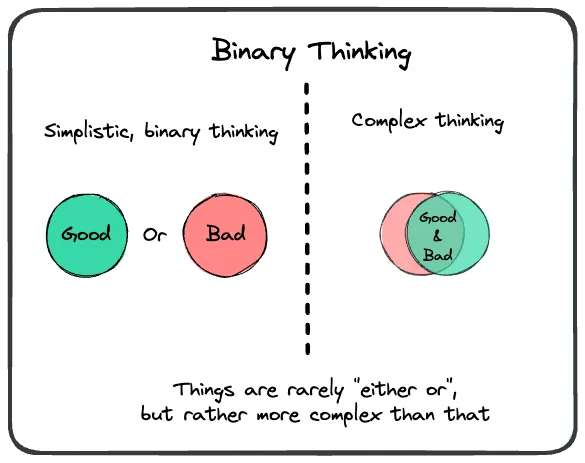
Binary Thinking
Notes
Claim
We sometimes see situations as a black-and-white, meaning that there is only one right move, and a clear distinction between the right side and the wrong side. Into those sides we often place people, using streotypes we classify them into groups of Group membership biases perception and shapes intergroup hostility, but it also could be about certain non-human related decisions. We tend to see the other side as our problem, instead of the actual problem People are not the problem.
Explanation
The problem with binary thinking is that our perception is highly limited and we will most often miss Win-win outcomes align interests and benefit all parties, or ignore the complexity of the situation, which means our solution will be inadequate, or even harmful. It has a "go big or go home" kind of attitude, which can cause us to dismiss opportunities that might start small yet have a Repeated actions yield exponentially increasing returns over time effect with time.
Similarly, binary thinking is usually connected to having a Fixed mindset assumes capabilities are unchangeable from birth. Success seems as a True/False condition, rather than a spectrum, or a matter of a personal mindset; you are either competent or not, ignoring the ability to grow and adapt over time, failure is bad, because it pushes you away from reaching your goal, ignoring the important lessons that it carries. You are either a good or bad person, ignoring the variety within ourselves, and the importance of detaching what we do with who we are to let ourselves grow past harmful behavior. Success is a zero sum game, to be successful we have to step on others, ignoring the benefits of cooperation.
It also gives too much importance to that threshold, if we achieved our goal we are winners, but if we were just one step behind we are losers.
Why it matters
Binary thinking is usually something that we want to avoid. One of the ways to do that is to Zooming out gains perspective through mental distance, to see the situation as a whole, explore other alternatives, understand the true boundaries of your decision, instead of settling for the two options in front of you. Another way is to embrace Diversity of perspectives strengthens decision-making and understanding. There is no one "right answer", truth is often contextualized, depending on the situation, the speakers, their world views. Truth is complex, and it changes over time. Lastly, we need to Inverse our thinking, to see things completely different, not as a world of "either, or" but rather a "yes, and". The more we expend our viewpoint, the better options we will have.
Examples
For example, you might reject giving consulting for free because your goal is to increase your earnings, so a simplistic metric for valuing an activity is "does it increases my income". Since free consulting is free you will likely say no, ignoring the potential that it brings in creating a client base, bring brand recognition, experience, etc.
It shows up in disagreement too: Debate treats disagreement as a zero-sum game treats the other side as having nothing worth taking, instead of looking for a shared solution.
Supporters
One concrete technique to escape it is Open-ended questions enable deeper understanding and meaningful dialogue, a question that can't be answered with a simple yes or no forces a wider, more honest exploration of the situation.
Opposers
Absolute rules trade flexibility for willpower savings makes the case for going binary on purpose: a rigid "never" is easier to maintain than a flexible "rarely", because flexibility is exactly what opens the door to excuses. Rules save willpower precisely by removing the in-between.
Open questions
If rigid, binary rules save willpower by removing the gray area, when does that trade stop being worth it — and how would we notice we'd crossed that line before it already cost us the nuance we needed?
Visual