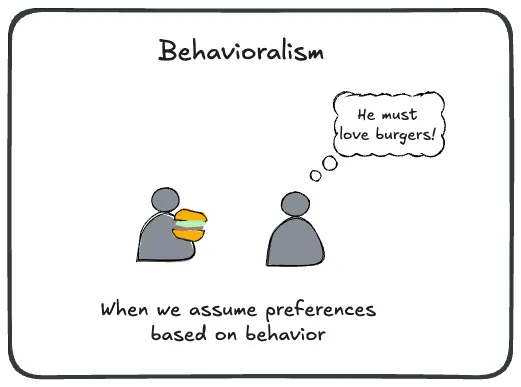
Behavioralism
Notes
Claim
Behavioralism is a theory which suggests that the best way of measuring someone's preferences is to look at their behavior. It assumes that Merging actions with identity blocks growth is common in most cases, meaning that our actions reflect our true preferences.
Explanation
The advantages are that it escapes the Understanding others requires attributing mental states like beliefs and intentions to them, no need to get into someone's head in order to understand what motivates them, we can look at their behavior and reverse engineer it.
Why it matters
It holds up best under the Econs are purely rational agents who maximize utility assumption, if someone has full information, willpower, and freedom to choose, their behavior really does align with their preferences. The theory's usefulness depends on how close to that ideal the person actually is.
Examples
Supporters
The same logic scaled down to the personal level is Self-knowledge can be driven by data, tracking your own behavior over time as a more objective route to self-knowledge than introspection alone.
Opposers
However, it fails to account for cases of Insight Gap, where we know what we should do yet we fail to do so, and ignores cases of intrapersonal conflict. It also undermines the reasons for choice architecture, because if people would have wanted a different outcome, they would have said so.
Open questions
Visual