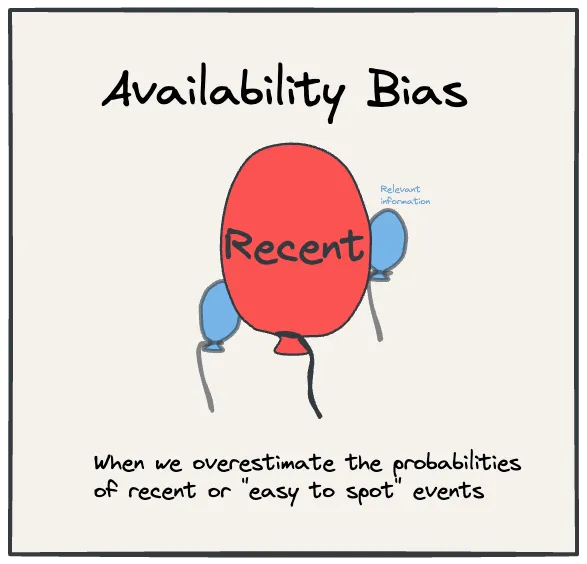
Availability Bias
Notes
Claim
Availability bias is when we think a phenomenon is more likely only because it is easier for us to remember the most recent case. It is related to What matters most is often less visible than what is salient because it's easier for us to think about salient cases rather than "hidden" probabilities of unknown events.
Explanation
It can also be related to the We prefer what is familiar over what is better, because the things that are easily available in our memory are probably very familiar to us. Similarly, if we are entrenched too deep in Conformation bias makes us accept confirming evidence without scrutiny, we essentially surround ourselves only with information that supports our views, regardless how limited or false it is, so "its no surprise" that we can recall it more easily and exaggerate it's importance.
It also assumes that Forgetting is an indication of importance, meaning that we won't forget the important things, so if something's forgotten then it's not important.
Survivorship bias runs on the same mechanism: we judge only by the data that made it back to us, missing everything that didn't survive to be counted We draw conclusions only from what survived.
Why it matters
This means that our views are highly affected by Actions and meaning depend on situational and environmental circumstances. Our thinking might change drastically if we change the type and frequency of information that we consume. It could also be the key behind views such as Pessimism is focusing attention on negative outcomes and threats and Optimism is choosing to believe outcomes can improve through action. Perhaps we become what we consume. If we only listen to bad news, we believe that they are more frequent than they are, and vice versa with good news.
Examples
For example, right after a natural disaster, we would think such an event is much more likely than it's actually is.
Supporters
The same logic shows up in Focusing on easy metrics blinds us to what matters, we search where the light is good rather than where we actually dropped the keys, mistaking ease of access for importance.
Opposers
The availability bias can also limit our creative thinking, because when we first try to brainstorm new ideas, we would come up with the most basic and common answers, which are hardly innovative.
Open questions
Visual