Motivational Scheduling
Notes
Claim
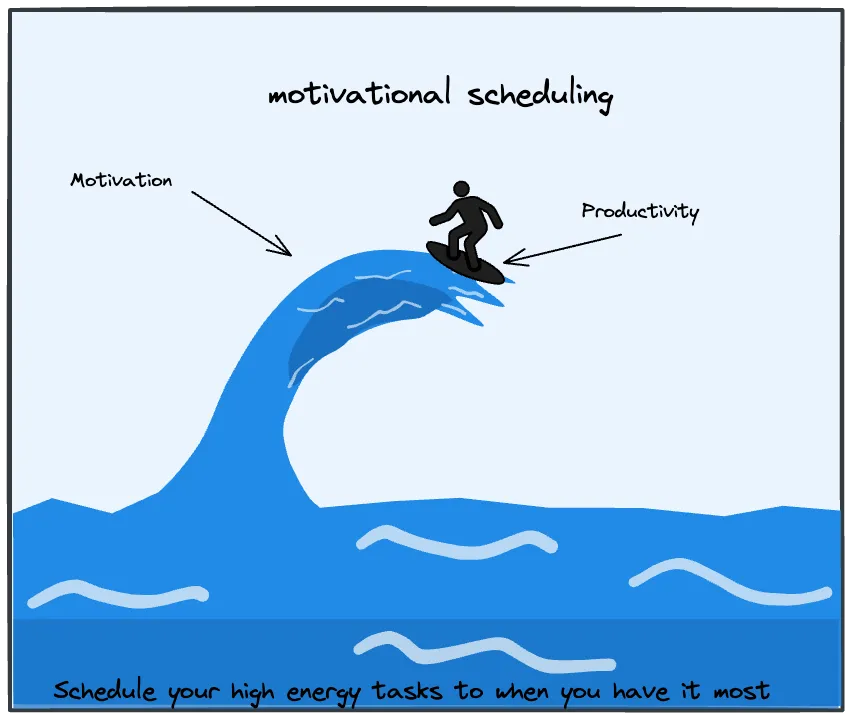
Motivational scheduling means that we determine our schedule based on our energy fluctuations, instead of trying to "force" ourselves to do something at a certain period of time Inverse Resonance is being in sync with reality and others. We try to match what we are doing to our current mental state, instead of forcing a mental state at a specific time.
Explanation
It also requires to modify our perception of time, from a linear one - aka all hours are equal, to a seasonal one. For example, an hours work at 1am won't produce the same results as an hours work at 10am. They are both 60 minutes worth of inputs (a "linear perception"), but they are not equal in levels of quality.
Why it matters
Examples
For example, if our creative energy peaks in the mornings, it makes much more sense to make time for writing in the mornings, instead of blocking time for writing at night, even if it is more convenient.
Supporters
Group similar tasks to reduce switching costs works on the same logic from a different angle, batching by energy demand so low-energy tasks don't compete with high-energy ones for the same slot.
Opposers
What happens if we don't have the energy to do this at any time of day/throughout the week? Hopefully a well placed deadline can help us come up with the necessary motivation. Otherwise our lack of energy will serve as an excuse for procrastinating. Motivation scheduling requires some form of Self-trust is the first step to trusting others in ourselves that we will be able to do this eventually, that the energy will come if we stop try to force it out of us. Regardless, if we don't have the energy to do something, we won't be able to do it even if we try to force ourselves to.
Open questions
Visual