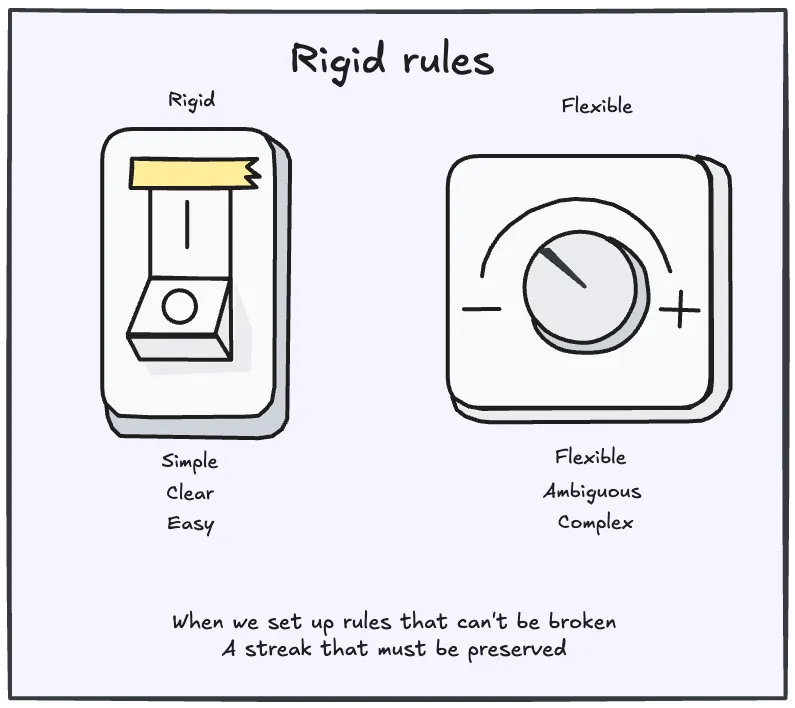
Rigid Rules
Notes
Claim
Rigid rules are when we impose on ourselves a rule with a type of ultimatum like "never" or "always", something that is always in effect no matter the Actions and meaning depend on situational and environmental circumstances. An example could be "I never watch tv".
Explanation
The advantage of a rigid rule is that it's easier cognitively to maintain than "I rarely watch tv" because the Flexability allows us to make excuses why "just this time" it's okay to break it.
Why it Matters
As time passes, our motivation shifts from Intrinsic motivation drives action through internal alignment and passion (the reason we set up the rule) to External motivation crowds out intrinsic drive and sustainability (maintaining the streak), which is problematic on it's own, even if the rule is maintained.
Examples
Supporters
Opposers
The downside of rigid rules is that once broken, they usually lead to the Breaking a streak kills all motivation effect. The same force that motivates us to maintain the rule - the Momentum is movement that builds self-reinforcing forward action of not breaking the chain is also it's downfall. Once a chain has been broken, it can't be restored. If you lost a streak of 2000 days on Duolingo, there's little chance that you'll have the motivation to continue studying as if nothing has happened.
Open Questions
Visual