The Practice of Groundedness (book)
✒️ Note-Making
Clarify
🔈 Summary of main ideas
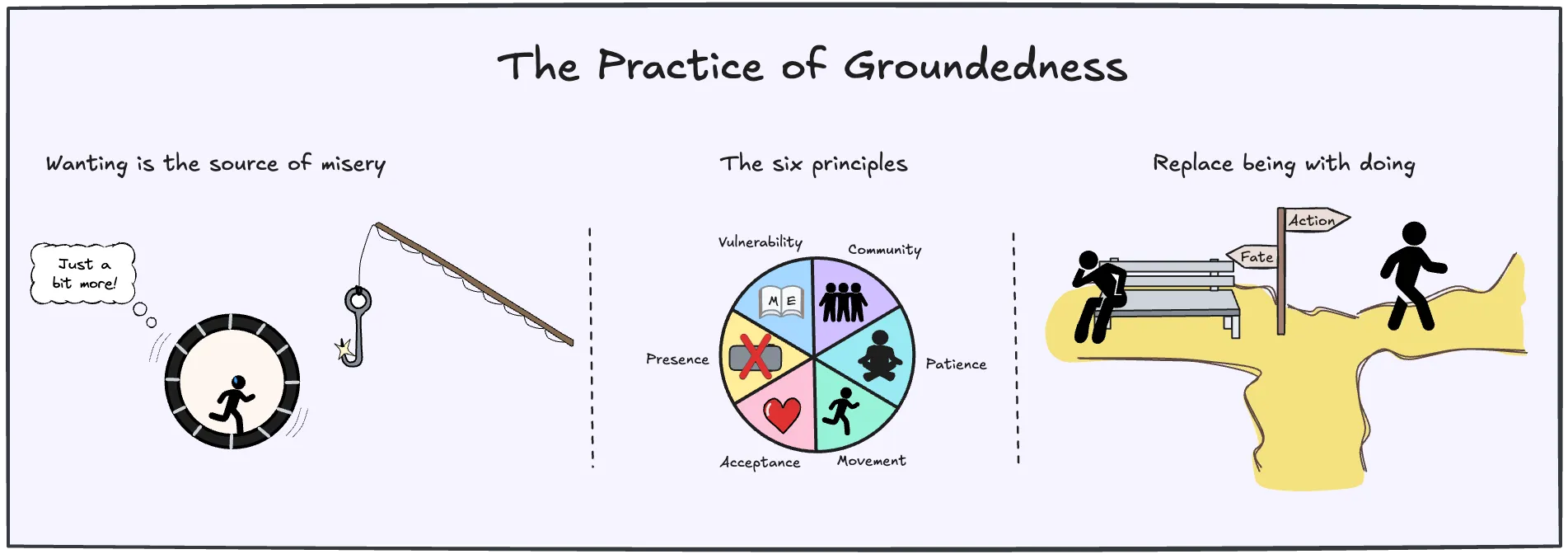
- Wanting is the source of pain - The popular opinion is that success is having a constant drive for more, to push harder and faster. This is a recipe for misery. A hole, a lacking in our hearts. Endless wanting leads to burnout as we are never satisfied with what we have. This is also a source of escapism, focusing on the next big goal as a distraction of the good in life.
- Groundedness is a practice, not a theory - Knowing how we should behave doesn't lead to any benefits. We need to practice what we teach, to live these principles daily.
- The six principles
- Acceptance - life is pain, any denial of that only increases the pain. Focus on what you can control, accept what you can't, and move forward. Embrace who you are, flaws included, and practice self compassion and healthy distancing.
- Presence - Without presence, we are at the mercy of distractions. The attempt to do it all and have it all is in itself a distraction, as we can only focus on one thing at a time. Your willpower is limited, so create the environment that promotes presence.
- Patience - Accept that some things take time. So we need to give it time to grow, not rushing results or expecting immediate results. The act of rushing usually makes things worse.
- Vulnerability - be real, authentic, vulnerable. Lack of vulnerability means the denial of parts of yourself. Without self awareness and acceptance, there can be no peace. Similarly others resonate with those who are authentic, that expose their flaws as they feel permitted to do the same, a shared problem.
- Community - Loneliness is a serious problem. Find your people, those who share your interests, who drive you to be better, that you can really be yourself with. Social media does the opposite, makes us feel even more lonely.
- Movement - Our body and mind are connected, to have a good life we need to take care of both. Incorporating movement daily is beneficial for prosperity and health.
Relate
⛓ by following this method, what will happen? What is the goal of this book? A more wholesome life, not chasing endless dreams that only leave us feeling empty and wanting for more. A feeling of happiness with who and where we are now.
Act
📋What should I do to achieve the goals set out by this book?
- Practice third-person self-talk – speak to yourself as you would a friend during moments of crisis to increase self-compassion and distance.
- Use mentor visualization – ask yourself what a mentor who embodies your values would do when facing a difficult decision.
- Design your environment for focus – keep your phone away at night or implement a recurring, day-long technology detox to remove distractions.
- Stop one rep short – perform slightly less than your capacity in daily tasks to maintain energy levels for consistent, long-term effort.
- Practice conscious breathing – take five deep, intentional breaths three times a day, following every breath from start to finish.
- Speak your authentic mind – voice your honest thoughts and feelings rather than hiding them to foster vulnerability and genuine connections.
- Commit to community participation – engage in volunteering, support groups, or community rituals to build belonging and accountability.
- Integrate hourly movement – walk or move your body for five minutes every hour to combat the sedentary nature of daily life.
- Journal for alignment – document your daily actions to assess how effectively they align with your intended identity and values.
- Focus on the process – disregard external outcomes and social comparisons, measuring your progress only against your own past self.
Critique
✅ relevant research, metaphors or examples that helps to convey the argument
- The Second Arrow – Metaphor (Buddhist parable) – Resistance to painful reality acts as a "second arrow" that intensifies and prolongs suffering. Supports: Resisting difficult life events makes them worse.
- The Happiness Equation – Conceptual framework – Happiness is calculated as reality minus expectations. Supports: Reducing unrealistic expectations is essential to finding contentment in life.
- Self-Determination Theory – Psychological framework – The theory that humans require three fundamental elements to thrive: Autonomy, Competence, and Relatedness. Supports: Meaningful fulfillment requires both individual control and deep human connection.
- The Hedonic Treadmill – Scientific concept – The persistent observation that human happiness returns to a baseline level regardless of external life changes or achievements. Supports: Chasing external goals and constant wanting will not lead to lasting life satisfaction.
- Sitting is the New Smoking – Metaphor – A comparison describing the harmful health impacts of a sedentary lifestyle. Supports: Regular, distributed physical movement is a non-negotiable requirement for mental and physical health.
- The Attention Economy – Structural observation – Media business models treat user attention as a commodity, using psychology to create "dopamine traps." Supports: Our modern digital environment is intentionally designed to undermine our ability to be present.
- One Rep Short – Coaching principle – The strategy of intentionally performing slightly less than maximum capacity during a session to ensure enough energy remains for the next day. Supports: Avoiding burnout requires prioritizing long-term sustainability over immediate, excessive output.
- Acceptance and Commitment Therapy (ACT) – Clinical framework – A method based on three layers: accepting conditions without judgment (cognitive distancing), choosing actions based on values, and taking action. Supports: True progress requires acknowledging current reality rather than escaping it or fighting it.
- The Stone Cracking Analogy – Metaphor – The observation that small, consistent impacts eventually shatter a stone, symbolizing how patience leads to growth. Supports: Consistent, long-term effort is more effective than rushing or expecting instant results.
- Emotional Contagion – Psychological mechanism – The process by which emotions, especially negative ones like fear or anger, unconsciously spread between people. Supports: Your choice of social circle directly shapes your internal state, making "who you surround yourself with" a critical factor for wellbeing.
❌ the logical jumps, holes or simply cases where it is wrong...
🧱 Implementations and limitations of it are... The second part of the book, the practical one is rather shallow. Some of it is because the practical tips already appear in the "theory" section, and some of it because each practice can be a book on its own, so other than "just do it" there's not a lot of insights there.
Review
💭 my opinions on the book, the writers style... I like the book's message, especially coming from a person that focuses on high achieving people, suddenly hearing a different side, one that speaks of slowing down and appreciating what you have is refreshing. I wander whether it is a mandatory step - that first you must work hard to become your best, only to discover a second mountain, or that happiness was the road you traveled all along.
Outline
Notes
The Principle of Grounded Success
Grounded to Soar
Many people are affected by heroic individualism. They see success as the most important metric, driven solely by your effort in a zero sum game against everyone Competition , while they are also filled with deep dissatisfaction, a feeling that they are never enough lacking, forcing to chase the next big goal as a form of Escapism Treating measurable metrics as complete truth hides importance focusing on ego and status leaves you empty.
this endless Wanting is a main source of Burnout and Depression. Because even when we achieve what we want, our happiness doesn't rise due to Hedonic Treadmill. Therefore happiness is not about constantly wanting more. It is instead to search for Stillness or groundedness. An internal source of strength that will enrich and empower our wellbeing. It is a boost to our happiness, fulfillment, wellbeing and even peak performance.
The pillars of groundedness are:
- Accept where you are to get where you want to go - accept who you are and where you are now Validation
- Be present so you can own your attention and energy - focus on the present, be physically and mentally present mindfulness
- Be patient and you'll get there faster - accept that some things take time rushing, so we need to give it time to grow, not rushing results or expecting immediate results. Play the long game, be patient.
- Embrace vulnerability to develop genuine strength and confidence - be real, authentic, vulnerable Vulnerability, Authenticity
- build deep community - prioritize people People First, Happiness is shared
- Move your body to ground your mind - moving as a habit connects your body and your mind
Groundedness is more than just a theory or a mindset, it is a practice. Learning by doing. Only by doing we can live by it.
- Even if you do a good job hiding it on the outside, with heroic individualism you chronically feel like you never quite reach the finish line that is lasting fulfillment. (Location 130)
- Groundedness is unwavering internal strength and self-confidence that sustains you through ups and downs. (Location 226)
- happiness is a function of reality minus expectations. In other words, the key to being happy isn’t to always want and strive for more. Instead, happiness is found in the present moment, in creating a meaningful life and being fully engaged in it, right here and right now. (Location 244)
- happiness, fulfillment, well-being, and sustainable performance arise when you concentrate on being present in the process of living instead of obsessing over outcomes, and above all when you’re firmly grounded wherever you are. (Location 318)
- Accept Where You Are to Get You Where You Want to Go. Seeing clearly, accepting, and starting where you are. Not where you want to be. Not where you think you should be. Not where other people think you should be. But where you are. Be Present So You Can Own Your Attention and Energy. Being present, both physically and mentally, for what is in front of you. Spending more time fully in this life, not in thoughts about the past or future. Be Patient and You’ll Get There Faster. Giving things time and space to unfold. Not trying to escape life by moving at warp speed. Not expecting instant results and then quitting when they don’t occur. Shifting from being a seeker to a practitioner. Playing the long game. Staying on the path instead of constantly veering off. Embrace Vulnerability to Develop Genuine Strength and Confidence. Showing up authentically. Being real with yourself and with others. Eliminating the cognitive dissonance between your workplace self, your online self, and your actual self so that you can know and trust your true self, and in turn gain the freedom and confidence to devote your energy to what matters most. Build Deep Community. Nurturing genuine connection and belonging. Prioritizing not just productivity, but people, too. Immersing yourself in supportive spaces that will hold and bolster you through ups and downs, and that will give you the chance to do the same for others. Move Your Body to Ground Your Mind. Regularly moving your body so that you fully inhabit it, connect it to your mind, and as a result become more firmly situated wherever you are. (Location 324)
Accept where You Are to Get where You want to Go
Life is often hard and painful.
Unfortunately our default reaction to difficult things is not to accept them rather try to escape them. We engage in motivated reasoning. We invent excuses why our situation is good even though deep down we know it's bad. By being in a state of partial Denial, we never fully experience reality fully.
Sometimes denial is expressed in a more activate manner, which means we fight reality as it is, which only increases our suffering Resistance amplifies suffering beyond the original source of pain, and the worst possible option is fighting yourself Self Criticism.
The key to happiness is to accept who you are now, not where you want to be, or where people expect you to be Happiness is contentment.
The more curious paradox is that self acceptance is necessary for growth.
Happiness is reality minus Expectations. If we expect too much of reality, we will only be miserable.
Since resistance is pain, a popular therapy method rose called ACT or Acceptance Commitment Therapy, which has three layers:
- Acceptance - Accept what's happening without judgment or attaching it to your identity Cognitive Distancing. Try to Zoom out and look at the situation as an external observer.
- Choice - choose how to move forward in a way that aligns with your values
- Take action - do so, even if it feels scary or uncomfortable
It is like the myth of the second arrow, by trying to resist we let ourselves get hit by the second arrow, which only prolongs and intensifies our suffering.
Accepting the situation is liberating, and allows us to focus on what we can control, on action and performance, achieving more than we thought we could while feeling better about it. Fear, stress, jealousy will always be there, we can't avoid it, but we also shouldn't try to fight them. It's like fighting flame with gasoline. Instead you should embrace them in a warm welcome Life as Flow.
To embody acceptance:
- Try to be the external observer, take a Pause and try to extend the space between stimulus and reaction
- If things are spiraling, practice Self-compassion. Speak to yourself in third person, talk to yourself as you would a friend self talk talking in third person creates distance and improves compassion
- Act in a way that's aligned with your values. Ask yourself what a mentor or person that embody those values would have done imaginary mentors help alignment with values
Say to yourself - this is what's happening and I'm doing the best I can
- Progress in anything, large or small, requires recognizing, accepting, and starting where you are. (Location 409)
- “The curious paradox is that when I accept myself just as I am, then I can change.” (Location 412)
- Instead of wanting things to be different and then being disappointed when they are not, you need to be with your reality as it is, not just for the highs but for the lows too. (Location 455)
- when you’re in a difficult or scary situation—be it physical, emotional, or social—resisting it almost always makes it worse. Far better is to accept what is happening; to open yourself up to it, feel it deeply, and let it be there. (Location 498)
- Accept what is happening without fusing your identity to it. Zoom out to a larger perspective or awareness from which you can observe your situation without feeling like you are trapped in it. Choose how you want to move forward in a way that aligns with your innermost values. Take action, even if doing so feels scary or uncomfortable. (Location 516)
- It’s completely normal to feel stress. It’s completely normal to find ourselves in unappealing circumstances. This doesn’t mean you are broken. It means you are human. (Location 527)
- When someone is honest with themselves and accepting of their reality, they gain a quiet and firm confidence. (Location 572)
Be Present so You Can Own Your Attention and Energy
The expectation to do more, to be everywhere all at once has severely hurt our ability to stay in the moment, to be present.
One option is pretending to be productive through Multitasking which only hurts our productivity because our mental capacity is split between different tasks, even if we don't try to focus on them Attention Residue.
Another option is more obvious distractions. The Attention Economy that uses our biology and psychology against us, creating dopamine traps that makes us hungry for more, but less satisfied when we get it, like empty carbs.
The quality of our lives is determined by the quality of our presence. The more we dedicate attention to the present, to what matters, the more rich our lives will be. Presence is what enables Flow
That's why it's important to get rid of Distractions, such as leaving your phone away at night or doing a day clean of technology Detox. It will be difficult at first, you'll likely notice signs of withdrawal, but it shall pass if you let it Surf the Urge, each successful resistance makes the next one easier Repeated exposure raises threshold.
It's very hard to rely on willpower alone when we want to avoid distractions. A much better way is to not meet them in the first place Environmental design.
Presence is mindfulness, a never ending struggle to keep your focus and remove clutter from your mind. It's impossible to be completely without thought. Distracting thoughts will always come, we just need to let them pass without judgment.
Presence is also the precursor for shaping our lives the way we want them. Only by controlling our attention we can control our actions presence is essential for agency. Otherwise we would just fall back to default behavior, releasing control of ourselves.
- We are at our best when we are fully absorbed in the present moment. (Location 886)
- the quality of our presence—its intensity and where we choose to channel it—determines the quality of our lives. (Location 973)
- when we are faced with great temptation, willpower alone is almost never enough. (Location 994)
Be Patient and You'll Get there Faster
Nowadays more than ever we have a tendency to rush things, to want results now. We focus on the instant gratification over everything else. However the more we rush things, the worse it gets The law of reverse effect
Patience is important because it connects us to the larger picture. Even if it looks like we don't make progress daily, over the long term we're still advancing every growth path includes a plateau. It's not that our effort is wasted, just sometimes it takes time to see the results, like small cracks on a stone that eventually break it Change happens suddenly once a threshold is crossed.
These results will come faster if we won't try to rush things, and be at ease. To Trust the Process, focusing on doing what you can, trusting that the goals will be done when they're done. That small consistent acts are the best way forward. And that sometimes, it's better to not do anything at all Wu wei, or Slowing down.
To make sure you don't burnout, stop "one rep short", do a little less today so you'll have the energy to continue tomorrow Overloading
The key point is slow is smooth and smooth is fast. When we don't try to rush things, we progress slowly but surely, which is the best (and fastest) way to reach your goals.
To improve our patience:
- Be without your phone - The phone represents our most instantaneous temptations. Trying to detox will give us the power to Delay Gratification
- Breath - three times a day, take five deep breaths, and follow them from start to finish. To consciously do nothing without immediately switching to action is also a good practice breathing
- Patience neutralizes our inclination to hurry, rush, and overemphasize acute situations in favor of playing the long game. In doing so, it lends itself to stability, strength, and lasting progress. (Location 1160)
- Cultivating patience serves as a buffer against getting caught up in frenetic energy and angst. It helps offset the temptation to seek novelty always and constantly change course. It invites us to show up reliably and thoughtfully, even when things appear to be moving slowly. (Location 1190)
- When people take on too much too soon, or convince themselves that they can suddenly leap upward in output, symptoms of burnout usually loom around the corner. (Location 1425)
- The less we depend on novelty and speed, the more we can make intentional decisions about when to seek newness and move fast versus when to stay put and slow down. (Location 1446)
Embrace Vulnerability to Develop Genuine Strength and Confidence
Many live double lives, we have who we present ourselves to be, and who we really are Form vs essence.
This is a great source of pain, both for the observers that see unrealistic standards, as if everyone else's lives are perfect and only we are miserable, and both for the presenters, that often feel Imposter Syndrome, because they know how big that gap is.
Vulnerability is key because it leads to self knowledge, self acceptance, and better connections with others, as it creates an opportunity for honest connection with those who experience the same issues. It also breeds Trust as people tend to trust those who expose their flaws. And it also creates Psychological safety, as others feel more comfortable sharing as well.
When we don't admit our flaws, when we are blind to them, we deny a part of who we are. It's like ignoring load sounds from the engine hoping everything will be okay, only to have the car fail shortly after. When we don't know what our problem is, we can't solve it.
That's why vulnerability and self knowledge goes hand in hand, to face our flaws is to know thyself
True confidence stems from Humility or intellectual humility. When we are aware to the extent of our knowledge, our words carry more credibility as we strive away from overconfidence or ignorance Confidence.
To be more vulnerable:
- Investigate your fears, their sources, and how can you use them as a fuel for action
- Speak your mind, don't hide your feelings/thoughts. As long as it's not harmful, say what you really want to say
- Remember that everyone is going through something
- facing your vulnerabilities helps you to more fully know and trust yourself, and to forge close and nourishing bonds with others. (Location 1551)
- intellectual humility, which can be understood as confidence gained by owning one’s limitations (Location 1650)
- Life is too short to go around pretending. The more real you can get with both yourself and others, even if you do so gradually, the better. (Location 1778)
Build Deep Communities
Humans are social creatures Human is a social being. We depend on connections in order to thrive, to feel fulfilled and happy. Without it Loneliness comes and with it depression.
The self determination theory claims that a person needs three things:
- Autonomy - control over our time and energy
- Competence - the feeling that we progress
- Relatedness - a connection and belonging
Loneliness is harmful because we need social connections to feel safe. Otherwise we're constantly scanning for threats, which increases stress and leads to lower productivity and satisfaction. It also creates a vicious cycle because when we see everything as a threat, we're worse at creating new connections which would get us out of this situation.
Social media can be quite harmful as well. Despite having more "friends" than ever, we feel even more alone Shallow copy. The only way social media can be a net gain if it facilitates interactions instead of replacing them social media is beneficial if it promotes face to face interaction. Meaning that if you use social media to create face to face interactions, than it is more useful than harmful.
Social media is also harmful because it is a breeding ground for emotional contagion Emotions spread between people through contagion. Especially for negative emotions like anger and fear. These are not emotions that are beneficial for connections.
You are the image of the people around you Interpersonal Identity, so we should pay attention to who we surround ourselves with. If we stick close to those who also with to improve the same way we do, that share our habits, that can teach us something, we will become better be a small fish in a large pond
There are several types of communities that could help you have a sense of belonging:
- Volunteering - we tend to befriend those we help volunteering connects us to those we give toteering connects us to those we give to
- Support group - they don't only make us more accountable, they also lift us up when we're down accountability partner
- Religion - it's a group with fixed rituals and a strong sense of meaning, that has the power to bring people together religion
- community and belonging are not “nice to haves” or ancillary elements of our existence. Rather, they are central to our essence, to our ability to be well and thrive. It is in our DNA. (Location 1847)
- if you are on your phone when meeting up with other people in person, regardless of age, the quality of those interactions deteriorates significantly. (Location 1979)
- It’s a one-two punch: community keeps you from falling, and if you do, it picks you up. (Location 2100)
Move Your Body to Ground Your Mind
Our body and mind are connected, when we move our body we also strengthen our thoughts Extended Mind, wellbeing and emotional resilience. While a life without movement is often filled with depression. We are not detached from our body, it is integral in our mental health, not just physical.
The main ways in which moving with our body helps our mental health is through facing discomfort. Most physical activity is hard, so it's a struggle we choose to embrace, to live with it, to listen to our body and know it's limits.
Movement also helps you recognize that gains don't appear overnight. They take time, and require an effort and rest cycles. If we train hard everyday, our body will crash rest is necessary for growth. It requires periods of rest to follow after hardships so that it will have time to recover and get stronger Allostasis.
We're not born to sit all day. Sitting is the new smoking. The best way to reduce it's negative effects is to spread movement throughout the day, for example to walk for five minutes every hour.
The golden rule is train often, sometimes hard, every bit counts.
- When we move our bodies regularly we do a better job of controlling our emotions, we think more creatively, and we retain more information. (Location 2225)
- Move your body often, sometimes hard; every bit counts. (Location 2387)
Living a Grounded Life
From Principles to Action
Theoretical knowledge doesn't change your life, doing is.
We need to align our identity and our actions Cognitive Alignment. Stop and think about how to implement the pillars of groundedness in your life, try to narrow it to as simple as possible, and start following this list.
Changing your life is easier said than done. To do so we have to use habits in our favor. To strengthen the good ones and weaken the bad ones. Like most things in life, whatever gets stronger is the one you feed what we pay attention to dictates our perception.
Think of concrete steps that can be done to create better habits (or destroy bad ones) in each of the six aspects of groundedness, like walking every hour, quitting social media every Saturday, etc.
Use Journaling to keep track of how much you aligned your identity and your actions.
Focus on the Process, Let the Outcomes Take Care of Themselves
Switching to a "doing" mindset means to cultivate a continuous habit of practice. To be grounded is not a matter of outcome to achieve, it is a process to embody.
The principles to keep in mind:
- Do the best that you can right now, focus on the process and results will come
- Be intentional in what you do, remember that you can't control everything, but there is much that you can, focus on that
- Don't be afraid to ask for help, and be with people who make you better
- Remember you will fail, don't let it stop you
- Don't compare yourself to others, only to past versions of yourself Comparing
Getting back on the path is not easy, it requires both the self discipline to get back on the path, and the self compassion to do so Recovering from hardship requires both self-discipline and self-compassion.
- We must do what we can to create lives that we are fully involved in—lives in which we cultivate acceptance, presence, patience, vulnerability, deep community, and movement. (Location 2881)
- Outcomes are short-lived and ephemeral. More than 99 percent of life is the process. (Location 2908)
- Do not worry about achieving a specific result. Focus on being where you are and applying the principles of groundedness to the best of your ability right now. If you concentrate on the process, the results you are hoping for tend to take care of themselves. Bring intentionality to everything you do. Keep coming back to the principles of groundedness and your actions for living them out. There is much about life that you cannot control, but there is also plenty that you can. Concentrate on the latter. Work with like-minded people whenever possible, and don’t be scared to ask for help when you need it. Asking for help is not a sign of weakness; it is a sign of strength. Take a long view and assume you will fail every now and again. If you expect occasional failures they won’t surprise you or throw you off course. They simply become part of the process, information that you can learn from and that will help you grow. Contrary to the cultural norms of heroic individualism, do not compare yourself to others. Compare yourself to prior versions of yourself and judge yourself based on the effort you are exerting in the present moment. (Location 2916)
- The best occasion to do what you wanted to do may have been yesterday, but the second-best occasion is today. Beating yourself up is a complete waste of time and energy. (Location 2954)