The Power of Language (book)
Note-Making
Clarify
🔈 Summary of main ideas
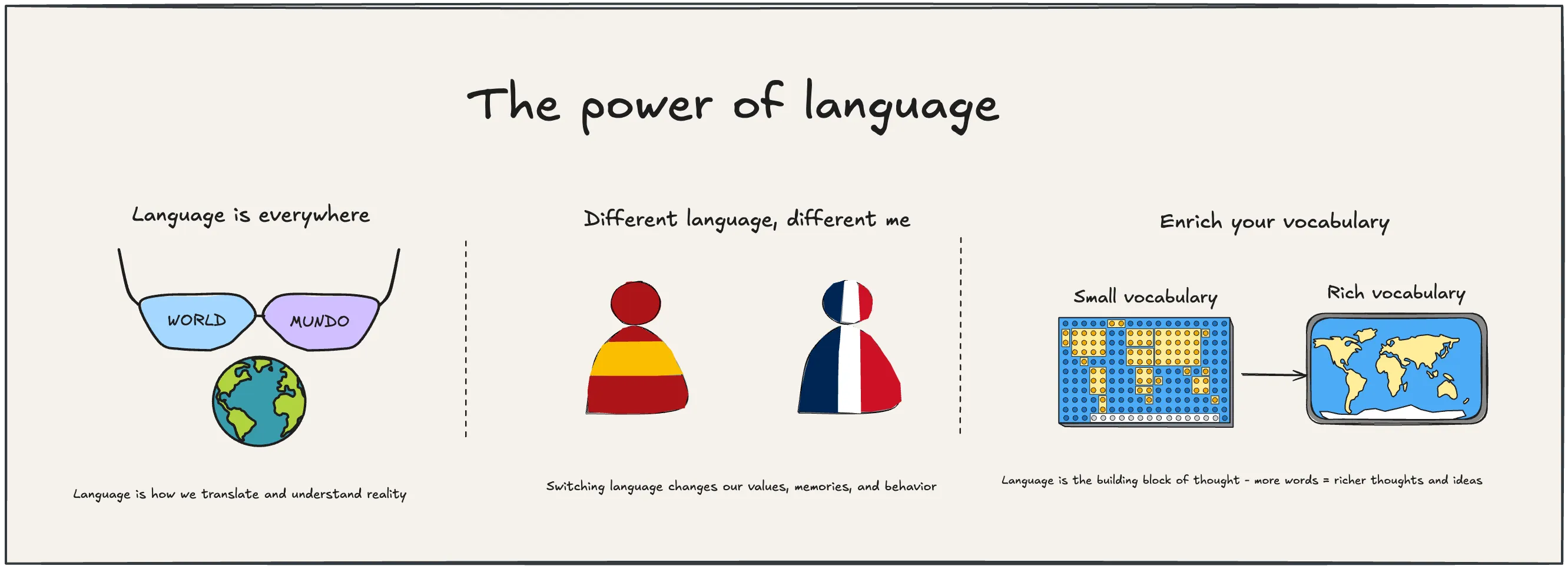
- Language is embedded in everything - Language isn't just a tool to describe reality, it is the colors by which we see reality itself. Our thoughts, memories, culture, all is embedded in the language we use. Like time and space, we can't conceive of human life without language.
- Different language, different me - Each language is like a different OS, a different copy of our identity. When we switch languages, we switch behavior, values and memories.
- Language supports creativity - since our vocabulary is the basis of our thoughts, the richer the vocabulary we have, the more insights we can generate using interesting and unique connections between words within and across languages.
- Language bridges and divides - by choosing how to phrase our ideas and beliefs, we can create groups, stereotypes, a sense of unity or an "us vs them" mentality. Wizards of words can with their speak alone change our internal narratives, beliefs and behavior.
- Language cools and warms - using non native language improves our logical thinking, while our native language supports emotional processing. We can use language as a tool to switch between mental states.
Relate
⛓ by following this method, what will happen? What is the goal of this book? I will have a broader understanding of reality, of cultures. I will have a richer vocabulary to paint my internal reality, and better navigate the world I will improve my cognitive abilities
Act
📋What should I do to achieve the goals set out by this book?
- Learn a second language – start learning a new language regardless of your age to improve brain health, boost cognitive functioning, and delay cognitive decline.
- Use immersion techniques – engage with a target language through direct immersion rather than just passive study to improve comprehension and fluency.
- Practice language with others – find a conversation partner to actively speak and practice the language with, as social interaction is key to language acquisition.
- Learn through play – make the language-learning process fun to increase engagement and aid in memory retention.
- Start early – teach children a second language as early as possible to maximize cognitive benefits like improved focus and theory of mind.
- Utilize language for emotional regulation – use a non-native language to trigger "cognitive distancing" when you need to reduce the emotional load of a situation.
- Expand your emotional vocabulary – learn specific words from other languages that describe complex emotions you otherwise lack labels for, to increase your emotional awareness.
- Switch languages for creative ideation – consciously switch between languages to trigger new word associations and "ripple effects," facilitating more creative connections and problem-solving.
- Adopt a non-native language for rational decisions – use a non-native language when you need to think in a colder, more rational manner, as it modifies your perspective and reduces emotional bias.
- Bridge gaps with mirroring – adopt the specific dialects or "plain" versus "fancy" language styles of the people you are communicating with to build empathy and improve connection.
Critique
🧩 relevant research, metaphors or examples that helps to convey the argument
- Moon gender variations – Cultural example where masculine-gendered moons are described as "strong and big," while feminine-gendered moons are described as "beautiful and magnificent." Supports: Language shapes our internal reality and perception, rather than just describing an objective truth.
- Political labeling impact – Societal example regarding the difference between labels like "slaves" versus "enslaved people" or "illegal" versus "undocumented" immigrants. Supports: The specific labels and language we choose immediately alter how we mentally represent the people or subjects being discussed.
- Non-native language logic – Scientific finding that bilingual individuals are more likely to think in a logical, rational way when using a non-native language compared to their native tongue. Supports: Language usage influences the emotionality and rationality of decision-making.
- The "ripple effect" of word processing – Cognitive metaphor describing how hearing a single word (e.g., "flag") simultaneously triggers semantically or grammatically related words (e.g., "state" or "flask") across all languages a person knows. Supports: We process language in parallel, using a wide-ranging neural network rather than a linear, word-by-word sequence.
- Linguistic framing of "attention" – Cultural analogy comparing how different languages phrase "pay attention" (Spanish "lend," French "made," English "pay," German "gift"). Supports: Language dictates the mode of thinking and informs how we interact with concepts.
- Neuroplasticity and gray matter – Scientific finding that language learning increases gray matter density in the brain and helps retain it during aging. Supports: Language acquisition is a physical process that biologically alters and strengthens brain structure.
- Multilingualism and dementia – Scientific finding showing that being multilingual is associated with better brain health, specifically delaying or reducing the likelihood of Alzheimer’s disease. Supports: The cognitive exercise inherent in multilingualism provides protective benefits for the aging brain.
- Future tense and hyperbolic discounting – Behavioral study showing that speakers of languages that do not distinguish between the present and future in their grammar are less likely to fall victim to hyperbolic discounting. Supports: The grammatical structure of a language influences values and long-term behavioral choices.
- Language as a memory trigger – Psychological observation that memory and language are coiled together, with specific languages acting as distinct cues for accessing certain memories. Supports: Because memories are embedded in language, switching languages can physically and culturally reshape one's identity and recalled history.
- The "Wizardry" of onomatopoeia – Linguistic example of words like a clock’s "tick" that exist as exact auditory representations of their concepts. Supports: Language is not always arbitrary; some words possess an inherent, sonic connection to the meaning they represent.
❌ the logical jumps, holes or simply cases where it is wrong...
🧱 Implementations and limitations of it are... Aside from "please learn another language", there's no real implementation or guidance on the topic. The book focuses on the advantages of being bilingual.
Review
💭 my opinions on the book, the writers style...
The book started off great, but declined with time. The two main reasons are:
- repetition - it seems the author wrote each chapter separately, as if it is not aware of which chapters exist. This caused a repetition in conclusions or anecdotes between chapters
- no bottom line - it's hard to know when an anecdote ends and when the conclusion begins. Chapters are just series of research papers without a clear conclusion, and often the story the chapter opens with is not clearly related to the continuation of it.
Outline
Notes
Introduction (or welcome)
Language is a curious, wonderful and powerful thing.
One debate is whether language describes reality (i.e sees things as is) Objectivism, or shapes reality (the language we use shapes our perceptions Social Construct) words shape internal reality.
A common example is gender of objects. In languages where the moon is masculine, we tend to describe it as strong and big. When it's feminine, we describe it as beautiful and magnificent. The "real" moon stays the same, but our internal mental image of the moon changes drastically just because we speak one language or another.
When we speak multiple languages, we are better at detecting this trick that language plays on us, and comes with a series of cognitive benefits Expanding perspective reduces blindspots.
- Does language follow along our latest, most improved understanding of the world, or does our understanding of the world follow along our language? (Location 90)
- The labels we use matter. Something as simple as changing the labels we use to refer to someone—for example, instead of slaves, saying enslaved people or people who were enslaved—makes an immediate difference in how we mentally represent those we are speaking about. (Location 123)
Self
Mind Boggling
Speaking multiple languages opens us to new ways of thinking, like seeing things from different angles changing psychical perspective changes mental perspective.
Language is deeply embedded in our memory. We don't just describe memories using language, they are part of the embedded memory memory is embedded in language. When bilinguals are asked about a past event, they answer differently depending on the language.
Language is also deeply embedded in our culture culture, so when we speak or spoken to in a certain language, it changes our personality/thoughts/behavior to match the culture of that language A person is a community.
Language also affects how rational we are. We are more likely to think in a cold rational way when speaking a non native language than our native one words shift between hot and cold states
- learning another language opens up another way of coding reality and new ways of thinking. (Location 189)
- People who speak more than one language or dialect have different linguistic, cognitive, and neural architectures than people who speak only one language. (Location 227)
- what we look at, what we pay attention to, and what we remember are influenced by the languages we know and happen to be speaking at any given time. (Location 246)
- Because language and culture are tightly intertwined, language functions as a vehicle for culture, and changing languages also switches cultural frameworks. (Location 275)
- A native language packs more emotional punch. Which is also why some multilinguals prefer the use of a non-native language when they feel they need some emotional distance. (Location 292)
- people make more logical and rational decisions in a non-native language (Location 306)
- language makes people different, bringing to the forefront different aspects of themselves, “turning on” different identities. (Location 320)
- When bilinguals switch languages, their networks of neural activation change as well, and with them, so do their perception and interpretation of reality, allowing them to move across multiple planes of neural co-activation—and hence, arguably, across multiple planes of existence. (Location 340)
The Parallel Processing Super Organism
We don't process each word we hear/read in turn, we process the whole content simultaneously transformers. Each word we process creates a ripple effect that also brings to mind words that are similar either semantically or grammatically. For example, hearing "flag" makes you think about "state" (semantic link) or "flask" (grammatically)
The ripple effect is 3d because this process also runs across languages. For example hearing the word "Pot" will also create a ripple effect for words related to "mouth" for English-Russian speakers.
What affects the size of the ripple effect:
- Similarity of words - closer words in meaning are more likely to pop up
- Similarity of languages - for example french and spanish are more likely to both pop up compared to Korean and english.
- Hearing a word in one language activates the spoken and written forms in both the first and second languages. (Location 429)
On Creativity, Perception and Thought
Since knowing and thinking in more languages creates a larger ripple effect, it also leads to better Ideation. More connections between words mean a higher chance for a creative idea Remixing.
The term linguistic determinism states that language determines thought. We can't think about concepts if we don't have the word to describe them (reminds me of 1984 that deleted words from the vocabulary) linguistic determinism- language determines the boundaries of thought.
Being multilingual is perhaps a key to weakening the determinism by opening our minds to new ways of thinking.
The author claims that linguistic determinism is not true in the sense that it limits what can be thought of, but rather how we think about it Language shapes mode of thinking.
For example, in Spanish attention is lend (you want it back), in french it is made (requires action), in English it's payed (valuable), and in German it is gifted (attention is a present). Similarly, speakers of languages that have more words for specific colors are better is at detecting nuances in shades.
- knowing multiple languages enables people to make connections between things that others do not see. (Location 546)
The Word Made Flesh
Language is not an isolated part of the brain, it is like an orchestra of the human brain. It is essentially an emergent property of the mind, because it starts with neurons who fire together wire together. We link experience into sounds, meaning intro words, until a meaningful structure is formed, which is what we call a language.
Learning a language also changes the body, and especially the mind Neuroplasticity. We gain more gray matter density, and lose less of it as we grow older.
Some claim that learning a language also leads to inter generational changes through Genetic Switches.
- Our capacity for language (all languages) can be considered an emergent property of the whole brain working in concert. (Location 876)
- Through experiences, our brains have the remarkable ability to reorganize and form new connections between neurons. (Location 910)
- learning another language changes your physical body. (Location 973)
Childhood, Aging and In-between
Being a multilingual has been shown as beneficial for brain health, reducing chances of or delaying diseases like Alzheimer.
For younger generations, study show that learning another language early on is beneficial for cognitive functioning, such as the ability to focus, better language comprehension, to have a theory of mind, etc.
Another Language Another Soul
We are a different person when we switch a language. It is the combination of the effects of the culture that language is tied to (for example when I speak Spanish I behave more like Spaniards). But it is also connected to the language itself. For example languages that have a weaker separation of future to present tense elicit weaker hyperbolic discounting for it's speakers. So both our behavior, our worldview, and even some of our values are modified by the language that's dominant in our minds at the moment The language we speak reshapes our identity and values.
It also elicit a different emotional response, when our native language feels more emotional than non native ones. That's why talking a different language is a form of cognitive distancing.
Multilingual people are also better at expressing emotions as they have more words for it. Each language has a word for a specific emotional state, like a word for "not going outside when it's beautiful" or "feeling pain without knowing why". These labels increase our emotional vocabulary.
Language and memory are also deeply tied together. As the language we hear determines which memories are triggered. The power of language is similar to the power of senses to bring us back to certain moments in our lives each language is a separate memory cue. Unfortunately, language can also be used for implanting memories. It is enough to mix false memories within true ones, to embed the false memories until they feel like your own.
- when multilinguals change languages, they access different cultural frameworks and mental perspectives of the world. (Location 1264)
- Speakers of languages that do not distinguish the future from the present in their grammar are more likely to engage in behaviors that benefit their future selves. (Location 1296)
- Humans develop language and life memories in tandem: the two are coiled together, supporting each other. (Location 1384)
Society
The Ultimate Influencer
Language is a powerful Soft power. The words politicians, influencers, and news outlet use shape political reality. The way events are framed, or how people are described, affects how they are perceived. For example if we define immigrants as "illegal" or "undocumented". Politicians are masters of that craft, adjusting their speech, their language, and descriptions to create the picture of reality they wish their audience will embrace. Like 1984, words can be tools of oppression, because they shape the boundaries of your thoughts.
Aspects of language such as dialects and slang are tools for either bridging between people or creating a divide. When we speak in the specific dialect someone else uses, we make connecting more likely and easier Mirroring. For example, speaking in "fancy" high language when addressing royalty or talking more plainly and "down to earth" when talking with blue collar workers.
However, when we speak differently than those around us, it can trigger stereotypical thinking because we immediately recognize that they don't belong to the same group as us.
- words are selected and new labels are created not because they perfectly reflect what they label but to change the perception of what they stand for. (Location 1577)
Words of Change
Stereotypes rely heavily on our language. The most common aspect is genders, the gender we assign to people, to objects, it changes how people and objects are perceived. Even names can lead to stereotypes, because people assume your origin, your gender, and your culture based on your name.
In the education system, it is vital to learn a second language in order to gain the benefits of multilingualism early on. It is also an equalizer, especially for the lower class that gains access to more global languages, or gain opportunities for assimilation, especially for immigrant communities.
Found in Translation
What's in a name? Is there no connection between a word and what it represents? Is it arbitrary allocation or could the sound of the word connect somehow to it's meaning? The simplest case is onomotophea, when the word is "exact" representation of the concept, like a clock's "tick". The word is the sound the object makes.
But even in other cases we see a connection, even on languages we don't know we can often make a good guess to what that word means based on how it sounds/the context around it.
The true wizards of words were the poets, who captured experiences through words be crafting sentences to the level of precision of vowels. Songs date back to before the written language, and has served as a means of transferring information and tradition across and within generations.
Other "wizards" are the translators, which are not only experts in both languages, but are also capable of translating the essence, subtext and even update references in order to make the same message go through in another language., which is harder to do if they use a word for word translation.
- People who already know two or more languages learn new languages faster and better than speakers of only one language. (Location 2401)
The Codes of Our Minds
Languages are created and evolved over time. Especially now at the age of AI, the distinction between "natural language" and "artificial language" becomes thinner. What is the difference between Esperanto and Python? both created artificially for facilitate communication in certain cases. What's the difference between computers who learn to understand english, and people who learn to understand Javascript?
languages are tools to communicate information in specific environments, in ways that make it easier for the recipient to understand the message. Some languages like cyphers, are meant to also protect the message from being heard by others.
The most universal artificial language of all is perhaps math, which has been used to describe much more than just numbers. From animals to music, to behavioral patterns, math can be seen as the root language of all.
The Future of Science and Technology
There is no thought without language, the two are deeply intertwined from womb.
Nowadays, thought (or language) can translate to much more than just words. There are devices that allow us to trigger objects, move our body, activate a computer with the "power of our mind".
In Conclusion - or Happy Trails
It's never too late to start learning a language, and never too early to teaching your child a second language.
Use immersion techniques, make it fun, find someone to talk to.