The Art and Science of Connection
✒️ Note-Making
Clarify
🔈 Summary of main ideas
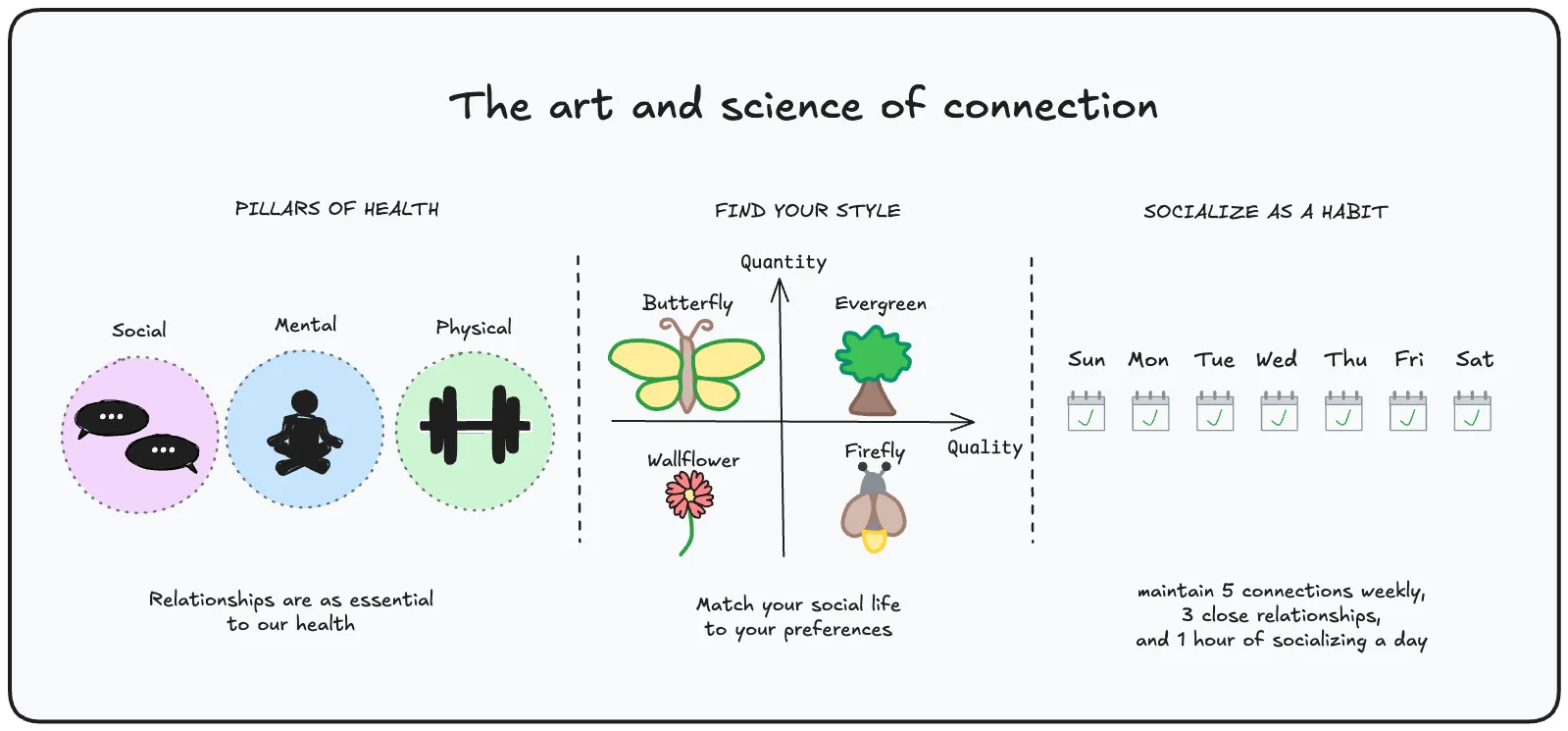
- Relationships are essential to our health - Health is not just physical or mental, it is also social. We require relationships in our lives. People to call to in an emergency, someone to be vulnerable with, friends we can share good moments with. It is as essential to our health as diet and low stress.
- What social health is:
- It takes two to tango - it's bidirectional. If you're the only one caring and reaching out, it's not a healthy relationship
- What goes down will come up - it ebbs and flows, there will be good and bad times. Moments where you are more "socially healthy", and moments of loneliness.
- Quality over quantity - the strength of social connections matter more than the volume
- One for all and all for one - social health is not just friends and family, it's also the community, the workplace, the culture we live in.
- Understand your type - we each have different social needs, so understand whether you are:
- Butterfly - many shallow interactions
- wallflower - few shallow interactions
- Firefly - few deep interactions
- Evergreen - many deep interactions
- Choose the right strategy - based on your personal preferences, and the quantity and quality of connections in your life, decide whether you should:
- Stretch - find new friends
- Rest - cut back on relationships that are meaningless/harmful
- Tone - deepen existing connections
- Flex - You're doing great!
- Social health is a process - Like physical fitness, it's not a "one and done", it's about maintaining a habit of connecting with people, both strangers or co workers, and friends and family. To spend quality time together, preferably face to face, focusing just on them.
Relate
⛓ by following this method, what will happen? What is the goal of this book?
Act
📋What should I do to achieve the goals set out by this book?
- Take Social Risks – Try to blend in with people you don't know yet.
- Find Common Interests – Seek shared hobbies or interests to connect with others.
- Automate Socializing – Turn social interactions into habits, like shared evening meals.
- Make Quick Calls – Utilize short periods, like 10 minutes, to call someone.
- Join Hobby or Volunteer Groups – Engage in groups based on hobbies or volunteering to meet like-minded people and build deeper connections.
- Engage in Deeper Conversations – Practice being a good listener, asking better questions, and showing genuine interest.
- Practice Vulnerability – Share your pain, struggles, and "true self."
- Express Gratitude and Kindness – Sincerely make others feel appreciated and perform small acts of kindness.
- Do the 5-3-1 method – Connect with 5 people weekly, maintain 3 deep connections, and spend 1 hour a day to socialize.
- Persist in Social Efforts – Do not give up on the first try, recognizing that people often like you more than you assume.
Critique
🧩 relevant research, metaphors or examples that helps to convey the argument
- Attributes of social health:
- It takes two to tango - it's bidirectional
- What goes down will come up - it ebbs and flows, there will be good and bad times
- Quality over quantity - the strength of social connections matter more than the volume
- One for all and all for one - you are an individual and a member of a community
- Types of social preferences
- Butterfly - many shallow interactions
- wallflower - few shallow interactions
- Firefly - few deep interactions
- Evergreen - many deep interactions
- Social Strategies
- Stretch - if the quantity is lower than you'd like, try to meet new friends or join a group.
- Rest - if the quantity is good, focus on maintaining the connections you have, or even scale back some.
- Tone - if the quality is low. Deepen your existing connections.
- Flex - if the quality is high - keep doing what you're doing:)
❌ the logical jumps, holes or simply cases where it is wrong... She says that quality is more important than quality, which personally I agree, but it contradicts the "archetypes"
🧱 Implementations and limitations of it are...
Review
💭 my opinions on the book, the writers style... It's a nice book, but it wasn't revolutionary. The assumption that we need relationships in our lives to be happy and healthy sounds common sense. The sections were mostly stories and little content, especially the parts that dealt with public policy which were more academic oriented but as a person not sure what I can do about it.
Outline
Notes
The Future of Health is Social
Health isn't just physical or mental-it's also social. To live a long and happy life, we need strong Deep relationships require trust, listening, and empathy, Human is a social being. Today, Loneliness is the painful state of feeling disconnected from others is more prevalent than ever and has a significant impact on our health.
- You can’t be fully healthy if you don’t have a name to write down as your emergency contact. If you don’t see family except for a few hours over the holidays. If you lack close friends to share experiences with. Or if you don’t have enough alone time to reconnect with yourself. (Location 380)
- Health is not only physical or mental. Health is also social. (Location 386)
- people not only are happier but also live longer when they have good relationships. (Location 431)
Asses - The Fundamentals of Social Health
Redefine what it means to Be Healthy
Health rests on three pillars:
- Physical - Caring for our bodies through sleep, a healthy diet, and exercise.
- Mental - Fostering emotional resilience and a healthy mind with practices like therapy, meditation, and journaling.
- Social - Connecting with others.
These pillars are interconnected and influence one another. For example, poor mental health can hurt your sleep quality, while social isolation can harm your mental well-being Actions spread effects across people and time beyond initial cause.
Research shows that strong social connections have several health benefits, including:
- A lower likelihood of getting sick or developing health problems.
- A faster recovery from illness.
- A reduced risk of mental health issues like chronic stress and depression.
- A longer life expectancy.
- Greater happiness and life satisfaction.
The impact of connection versus loneliness on our health is as significant as the effects of smoking or obesity Strong social connections improve health.
Social health is inherently positive. It's not about simply avoiding loneliness, but about thriving through meaningful relationships and finding purpose, rather than just preventing harm.
- The physical, mental, and social pillars support each other and together sustain the health temple. (Location 567)
- the stronger the ties, the better chance they have of staying healthy and recovering. (Location 682)
- having close relationships seems to be as important as exercising and not smoking when it comes to maintaining our cognitive abilities as we age. (Location 758)
- We need to invest in our ties to friends, family, and community as if our lives depend on it—because they do. (Location 790)
- the absence of illness is not the same as the presence of wellness. Addressing the negative is insufficient without also promoting the positive. Helping people survive is just the start; we also need to help people thrive. (Location 895)
Demystify Your Relationships
There are three steps to measuring the quality of your social health:
- Identity the sources
- Relationships - who is your emergency contact? Who you can call to late at night? Who would you lean on in tough times? Who would you invite to an important party?
- Communities - which groups are you a part of? Do you feel like you belong?
- Other connections - god, pets, fictional characters
- Measure their strength - are your connections mutual? Do they feel close to you as you to them? Do both sides reciprocate support? Are the relationships strong? It's better to have quality over quantity Quality of connection matters more than quantity of time.
- Decide on a strategy - it might vary with time, but the options are:
- Stretch - if the quantity is lower than you'd like, try to meet new friends or join a group.
- Rest - if the quantity is good, focus on maintaining the connections you have, or even scale back some.
- Tone - if the quality is low. Deepen your existing connections.
- Flex - if the quality is high - keep doing what you're doing:)
Remember that what's true for you is not necessarily what's true for others. Find the your social health sweet spot. For example introverts might thrive with a small group doing intimate activities, vs extroverts who prefer large events.
Your social health, as physical health, requires constant maintenance, and will change over time, especially if not invested in Relationships require constant maintenance.
- The sources of social health are what contribute to you feeling connected, and they fall into three main categories: relationships, communities, and other connections. (Location 947)
- If you don’t have as many sources as you would like, your strategy is to Stretch: make new friends, join or build a new community, and generally broaden the number of people and groups you can connect with. (Location 1076)
- If you have as many sources as you need or want, or more, your strategy is to Rest: maintain or scale back the number of relationships or communities in your life. (Location 1083)
- If you are dissatisfied with the strength of your sources, your strategy is to Tone: deepen your connections with your existing relationships and communities. (Location 1091)
- If you feel content with the strength of your sources, your strategy is to Flex: sustain the bonds you have formed with others. (Location 1098)
Reveal Your Social Health Score
Based on the preferred frequency and depth of interactions, so are either a:
- Butterfly - many shallow interactions
- wallflower - few shallow interactions
- Firefly - few deep interactions
- Evergreen - many deep interactions
Knowing your style will help you decide which strategy to pursue. As a general rule, it's best to stick with the 5-3-1 principle:
- Connect with 5 people weekly
- Maintain 3 close connections
- Spend one hour each day socializing
This is a basic recipe for good social health, same as eat food, mostly greens, not too much is for physical health. This makes sure you decide enough time throughout the week for developing strong connections, while also diversifying your sources.
There are blockers for social health, such as:
- racism Group membership biases perception and shapes intergroup hostility
- problematic childhood
- social media Our attention is the product that media companies sell
- social norms/policies - for example more individualistic societies experience more loneliness
- First, connect with five different people each week. Second, maintain at least three close relationships in general. And third, dedicate at least one hour each day to social interaction. (Location 1378)
Act - the Practice of Social Health
Make Social Health a Priority
Being social is important, but it's not easy. You have to take a risk and try to blend in with people you don't know yet. There is no other way to make friends. Try to find a common thread that will connect you, like a shared hobby.
You also might get distracted or feeling that you just don't have the time to socialize Hustle culture equates busyness with progress and causes burnout. The more stressed we are, the less likely we would even think about investing time in socializing Stress reduces investment in relationships. Remember that social health is just as important as other goals in life, as it a key pillar for your wellbeing.
Make do with the time you have. Don't have a full hour? Take 10 minutes to call someone. Also try to automate it as much as possible by turning it into a habit, like shared evening meals. It will help you maintain the activity without it being overrun by "urgency"
Strengthen Your Social Muscles
Just like workouts, it takes time, but as time progresses you get better at it We grow stronger by adapting to stress There are methods for improving your social health:
- Hobby groups - find groups of like minded people that you will get easily comfortable with
- Volunteering - helping others is not only a good way to connect, it creates a deeper connection because both sides benefit from it (you both become happier) Helping others benefits the helper too.
- Deeper conversations - be a good listener, ask better questions and show genuine interest in the other party
- Be vulnerable - share your pain, your struggles, your "true self", worts and all. Vulnerability is emotional openness enabling authentic connection
- Express gratitude - be sincere, make them feel appreciated.
Take One Small step for You, One Giant Leap for Social Health
Just as you don't have to exercise seven hours a day to be fit, you also don't have to invest too much time to gain the benefits of social health.
You'll be surprised how small acts can have meaningful effects Repeated actions yield exponentially increasing returns over time
So you should do things like:
- Invite someone for lunch
- Make a 10 minute phone call
- Express gratitude or make a small act of kindness
- Introduce yourself to strangers
Any one of those things is a small step that can lead to a meaningful strong connection down the line.
- the right steps, even when small, lead to giant leaps of progress. (Location 2269)
- People enjoy hearing from you more than you think. (Location 2345)
- It takes courage to reach out and try to connect, just as it takes courage to date and try to find love. Sometimes it will go well; sometimes it won’t. But it is absolutely worthwhile. (Location 2477)
Think like a Scientist, even if You're not One
It's not easy to find friendships, but also we don't always know our own preferences. That why we need to treat our social life as an Experimentation.
You can try our several social clubs, or conversations with someone, if it doesn't work out that's okay, just move on to the next opportunity. A "failed" connection says nothing about you personally Separating actions from identity allows growth, only on the quality of the Good decisions match the best option for both sides
However, be aware of the liking gap, we tend to underestimate how much people like us and assume the worst, so don't give up on the first try.
Remember to take it easy and enjoy your experiments, and don't be too hard on yourself or others if it doesn't work out.
- We should all have high standards when it comes to whom we spend time with. (Location 2627)
- You’re not going to get along with everyone, and that’s okay. You still have self-worth.” (Location 2660)
Amplify - Social Health as a way of Life
Build Communities where You Live
Communities are the glue that connects us to others in a scalable way. Not just coworkers or childhood friends, but a network of people, of friendliness behavior that helps us feel welcomed and Belong.
The key is to find the "third places" that serve as a natural gathering place, such as a library, a coffee shop, a park, and be there Third places anchor community connection. Find your local community leaders who create social gatherings and follow their lead. Turning strangers into neighbours has a huge impact on your social health. Community
Nurture Connections at Work and Online
Work is an important part of our social life, as we spend most of our day there. This could be a great opportunity to improve our social health and our productivity at the same time. You can try to:
- Invite colleagues for lunch
- Introduce yourself or even mentor new workers
- Send thank you messages for people who helped you
It's important to remember that much of the work culture is dictated from above, through norms like remote work, compensation, meetings and work hours.
You should decide whether this work culture is best for your social health.
The rise of the internet and social media created many opportunities for Stretching and meeting new people, but we must be careful to not treat these friendships as real or as deep as real face to face friendships Shallow copies mistake partial representations for complete truth. Digital tools are great for creating the spark, but you must put the effort to keep it alive Digital tools ignite connection, effort sustains it.
- a human-to-human relationship is a rose. It requires constant nurturing, needing to be watered and fertilized regularly. It might hurt you, with sharp thorns that could prick your fingers. But the result of that effort and risk is hopefully a beautiful, fragrant, vibrant bloom. A human-to-bot relationship is a faux flower. Surely, a plastic stem and fabric petals will never be as rewarding as the real thing. (Location 3402)
- Flourish Together (Location 3453)
- Know that the love you show them leaves an indelible mark. When you spend time with them, show up for them, and tell them you care, you may be influencing their health and well-being for the rest of their life. (Location 3723)
Flourish together
Improving social health is also a matter of policy, and can be treated as a form of Handle problems while they are still small. If schools will teach social skills as much as they focus on academic skills, we will be so much better off. We would have a thriving, healthy, happy society, one where loneliness is not a common problem.