Success is a numbers game
Note-Making
Clarify
🔈 Summary of main ideas
- It's all about the odds - each goal has a success rate. Your task is to increase it as much as possible
- Don't believe base rates - general statistics are too broad and abstract, they're not tailored for you
- Don't settle for your current odds - you can hope to get lucky, you can try countless times, but the most efficient method is to increase your odds.
- Focus on the biggest risk - find the most likely negative outcome and do what you can to reduce it. You're only as strong as your weakest chance.
- You can't guarantee success - there's always a chance that something will go wrong. You have to accept that you might fail. All you can do is make it less likely.
- Don't forget the basics - sleep, nutrition, decision fatigue are all potential risks for bad decision making. Inversely - experimenting, starting small, and relying on others can boost your success rates.
Relate
⛓ by following this method, what will happen? What is the goal of this book? More likely of achieving the goals we're pursuing
Act
📋What should I do to achieve the goals set out by this book?
- Identify and address your weakest link – determine which step in your process has the lowest likelihood of success and improve it first to increase overall odds.
- Execute the most difficult step first – front-load the milestone most likely to fail to "fail fast," which reduces the cost of errors and accelerates learning.
- Minimize the number of steps to a goal – reduce the complexity of your plan by pursuing paths with fewer milestones, as every added step lowers the total probability of success.
- Conduct a pre-mortem – list all critical points required for success and estimate potential bad outcomes for each to prepare for or prevent them.
- Arrange tasks by failure probability – organize your success diagram from the most likely to fail to the least likely to focus your efforts on high-risk areas.
- Apply a "Success Diagram" to communication – use your map of critical points and risks to synchronize with your team or clearly define what help you need from others.
- Generate multiple alternatives simultaneously – avoid settling for the first idea by forcing yourself to find many options, increasing the chance of finding an optimal path.
- Delay important choices during physical or mental fatigue – avoid making decisions when you are hungry, sleep-deprived, or experiencing decision fatigue to prevent "stupid mistakes."
- Assess decision reversibility – prioritize paths and decisions that are easy to correct or reverse over those that are permanent.
- Start with small, manageable goals – break down a large objective into smaller milestones to reduce resistance and build momentum through visible progress.
Critique
🧩 relevant research, metaphors or examples that helps to convey the argument
- The Probability Multiplication Rule – Mathematical principle stating that the overall success probability is the product of each required milestone. Supports: Accurately calculating success rates rather than estimating based on disconnected base rates.
- The Weakest Link Principle – Theoretical constraint asserting that max success probability is anchored to the most improbable prerequisite step. Supports: Prioritizing the most significant bottleneck before beginning a plan.
- The 100% Probability Axiom – Logical framework declaring that for any event, the sum of all possible success and failure outcomes equals 100%. Supports: The strategy that reducing the likelihood of failure automatically increases the likelihood of success.
- The Inevitability Principle – Statistical concept suggesting that given a sufficiently high number of attempts, even unlikely outcomes become nearly certain. Supports: Validating "playing the numbers" as a legitimate and effective strategy for success.
- The Pre-Mortem Technique – Thought experiment involving the systematic envisioning of every "Potential Bad Outcome" (PBO) before starting. Supports: Proactively identifying failure modes to minimize risk.
- Biological Decision Pitfalls – Physiological observations that internal states—specifically hunger, sleep deprivation, and decision fatigue—impair cognitive judgment. Supports: The necessity of managing physical health to prevent systematic, "stupid" errors.
- The Failing Fast Strategy – Logical method of reordering project steps to address the least likely or most difficult tasks first. Supports: Minimizing the sunk costs of failure and increasing learning speed.
- Failure Repurposing Model – Strategic framework that treats a failed attempt as data to be integrated into the next, superior iteration. Supports: Converting the loss of a round into an improved competitive position.
- Reverse Probability Hacking – Strategic concept centered on identifying and increasing the likelihood of failure for an opponent. Supports: The argument that creating "unfair" advantages is a valid and necessary part of success.
- The Compounding Effect – Principle observing that success creates returns that grow exponentially over time. Supports: The imperative to start, earn wins, and move toward goals as early as possible.
❌ the logical jumps, holes or simply cases where it is wrong...
He criticizes non mathematical methods of achieving success like having a detailed plan, grit and maintaining motivation, yet he suggests these very methods again at the end.
These do not conflict with his theory, they might be described as an implementation of it.
🧱 Implementations and limitations of it are...
The section about probability hacking at the percentages level is an exaggeration and unrealistic section of the book. It's very hard to accurately measure your chances, we are very bad at making predictions.
Review
💭 my opinions on the book, the writers style...
This book takes a mathematical approach for achieving your goals, in a way that's easy to understand and relate to.
It's borderline "too simplistic", but it's a useful tool in the toolbox to have.
Outline
Notes
Introduction
In every aspect of our lives, there's a hidden probability that affects our success rate.
We don't have to settle for the chances we have, rather we can hack them in our favor Taking active control rather than accepting circumstances passively.
The Four Paths to Success
The are four ways of being more successful:
- Increase of chance of winning
- Reducing the chance of losing
- Being lucky
- Playing more Generating multiple alternatives simultaneously improves outcomes
Every goal you're trying to accomplish has two stats, chances of success and failure. We either manipulate either of these numbers, get luckily, or we just play enough times until we hit the jackpot.
Three unhelpful paths:
- hoping for luck
- aiming low
- Grinding (try and try again)
Path 3 is the closest to "okay", but it takes time, and you want to reach success early because success compounds.
The better path - probability hacking. It is a manipulation of your success rate.
- hidden in every area of life, subtle factors are impacting your odds of success. (Location 114)
- You don’t have to settle for the odds you’re dealt. (Location 117)
- Every goal that you’re pursuing has two hidden numbers attached to it: a probability of success and a probability of failure. (Location 273)
- success isn’t reserved for people who are probability privileged or enviably lucky. Success is a numbers game. And sometimes, you don’t have to beat the odds; you only have to play them. (Location 331)
- Is it possible the most accomplished people in the world aren’t merely the most talented, or the luckiest? It appears that trying more than the average person is what truly sets at least some of them apart. Through numerous attempts, they play the odds. (Location 416)
- given enough attempts, unlikely outcomes become nearly inevitable. (Location 448)
- reaching your goals faster can help you accomplish more afterward because your rewards will have more time to compound. So the sooner you can start collecting wins, the better. (Location 509)
Understanding Your Odds
Even though estimating your own odds is prone to biases such as Conformation Bias and Over confidence, it is still better than looking at base rates, because these rates:
- Might be biased too - most sources of information contain distorted rates such as "one in a million"
- Represent the average - your chances to be in the NBA might be slim if you're an average height, but if you're very tall then it's very likely. Meaning these rates lack Context Regression towards the mean
- They're strategy agnostic - raw numbers often ignore "dumb" or inefficient choices people make that lower their chances Aggregated statistics hide individual variance
- They don't into account repeated attempts - you might have low rates on your first try, but if you try again your rates go up
When calculating your actual success rate, take into consideration:
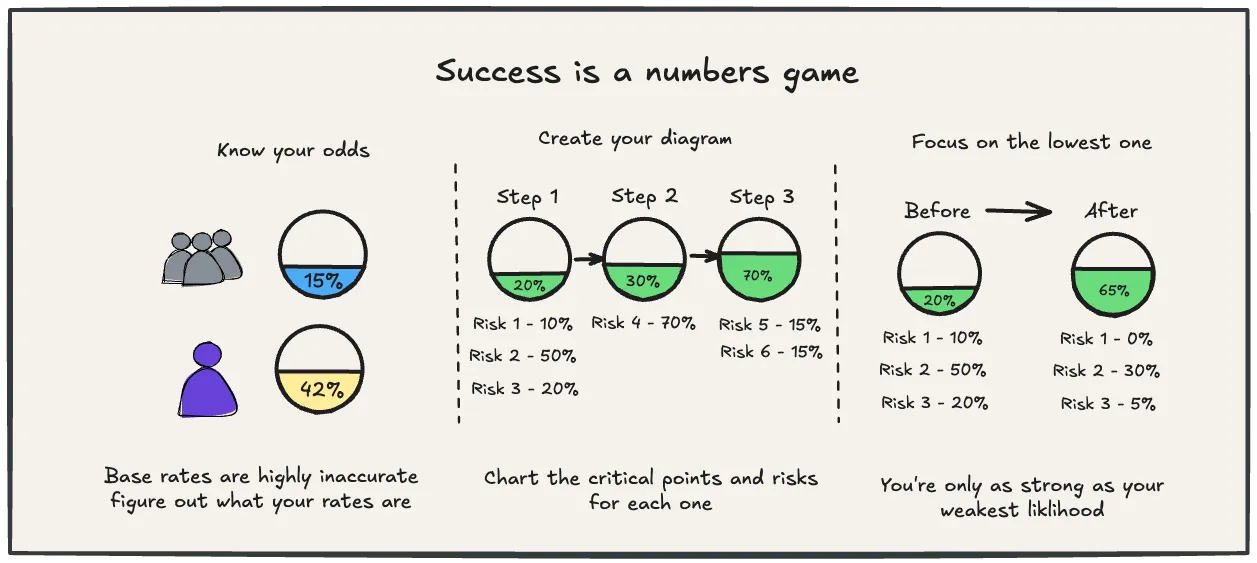
- Multiplication of all milestone probabilities - if you need to things to happen to succeed, and each is 50% likely, your overall success rate is 25%
- You're only as strong as your weakest chance - your chances are by definition equal or lower to the step with the lowest likelihood. You'll want to improve this step first. Instead of working chronologically, try fulfilling this step first, this will allow you to "fail fast", reducing costs of errors and learning faster. theory of constraints
- More steps = lower chance - every added step only lowers the overall odds. Pursue a path with less step.
- Every completed step is a win - every successful step improved your overall odds.
- Small advantage goes a long way - changing the lowest chance upwards can have drastic effects on your overall odds. If it's an area you have an advantage, you will be ahead. bottleneck
- Base rates don’t know anything about you, and that’s a problem. (Location 618)
- any progress you’ve already made toward your goals has improved your likelihood of success. (Location 686)
- Your odds of accomplishing a goal can be understood as the odds of each thing that must happen in order for you to succeed, multiplied together. (Location 714)
- Your odds of achieving a goal will never be higher than the odds of your most improbable prerequisite step. (Location 761)
- All other things being equal, the more steps that have to go right for you to succeed, the lower your odds of success. (Location 792)
- If your current path to success requires a long list of prerequisites, you might benefit from pursuing a different path with fewer steps. (Location 798)
- Reordering your steps, when possible, from least likely to most likely is a clever way to “fail fast.” It helps you limit the costs of failure and more quickly identify goals you can confidently commit to. (Location 814)
- Every time you complete a required step on the path to achieving your goal, your odds of success will go up. (Location 825)
- If you have an advantage on even one unlikely step, your odds could look enormously different from the average person’s. (Location 889)
How to Create a Success Diagram
Success is "simple" - reduce the chance of a negative outcome. In probability, it always sum to 100%. If we reduce chance of failure, we increase chance of success. Change from someone who can succeed to someone who should succeed.
- Start listing all the steps (aka critical points) that have to happen in order for you to succeed.
- For each, estimate all the potential bad outcomes. This will require a Pre-Mortem process of envisioning every likely thing that can go wrong.
- Arrange your diagram from most likely to fail to least
- Do your best to remove or reduce the risk of the these outcomes
Always look for a better way of doing things, like applying through a referral instead of blind applications. Also search for solutions that solve several issues at once.
Having a good success diagram makes communication easier, whether you're asking for help or synchronizing your team Clear plans make communication and coordination easier. It also makes Post-mortem easier since you can pinpoint to the exact risk that failed you Failure
- For every event, the odds of all possible outcomes add up to exactly 100 percent—no more. (Location 923)
- “Minimize the likelihood of potential bad outcomes.” (Location 954)
- “I don’t have to settle for the odds I’m dealt. If I don’t like them, I can change them.” (Location 1003)
Probability Hacking
Same as the previous section, but now you try to estimate the probability of success for each critical point, which is the reminder of the total probability of any of the bad outcomes occuring probabilistic thinking. For example if two bad outcomes are possible, one with 25% probability and the other with 40%, then the success rate of that step is 35%.
Remember to be wary of base rates. Your goal then is to reduce the likelyhood of those bad events.
Also remember to update your prediction as reality changes around you. New inputs requires an overview of your plan.
- every step where a goal can die is a critical point. Every reason it could die is a PBO. (Location 1488)
Making Smarter Decisions
There are some conditions that push us towards "stupid mistakes", which can derail our entire process. These are:
- Being hungry - making decisions on an empty stomach makes you more Present Bias
- Loss of Sleep - sleep is key for cognitive functioning
- Decision fatigue - the 10th choice is harder than the first. If needed, take a Break
- Emotional hijacking - when we're swept by emotions into poor judgment
How to avoid these pitfalls:
- Generate more ideas - The first ideas we have are usually the worst First attempts are inherently lower quality than iterations. We often miss the best option simply because we haven't searched long enough to find it. The more ideas we have, the higher the chance one of them is the optimal one
- Measure vs your goal - For the top ranking options, measure how they affect your success diagram. What makes an option better is whether it brings you closer to fulfilling your goal
- Choose the better path - To do so, consider:
- The alternative - Every choice costs the alternatives you gave up, what are you losing by choosing each option
- The status quo - is either option better than continuing with things as they are We prefer existing situations over alternatives despite better options
- Going back - are some decisions irreversible? Decisions that are easier to correct are better than irreversible ones. Decision weight depends on magnitude and reversibility
- The risk - What are the risks you're imposing by choosing this option
To make sure you've escaped your blindspots, be sure to Zoom out and Inverse your thinking, try to see what you normally miss.
And remember that even good decisions can fail, that's how probability works. It doesn't make it a worse decision. Judge the process not the outcome
Quit only when it Makes Sense
We have a tendency to quit after a failure, but it can actually be repurposed for increased chances of success. We can take what we've learned from the previous round to improve our chances in the next one.
Additionally, we can continue working towards our goal despite hardships through grit:
- Experimentation - When something doesn't work, try a different path Experimentation is the only reliable way to improve and discover truth
- Start small - Don't try to reach the top in the first step, have a small, manageable goal that's more easily reached Starting small reduces resistance and builds momentum for change
- Connect with your passion - Reflect on what you're willing to suffer for Passion is deep desire that sustains intrinsic motivation through difficulty
- Celebrate small wins - Visible progress sustains motivation
- Find a friend - motivation is easier when you have someone who's backing you up, lifting you when you're down Peer support
- Start fresh - use the Fresh start effect in your favor.
Whatever you do, don't burn the boats. You want to have the option of changing your goal when you realize it's a hopeless path.
- After experiencing a failure, the temptation is often to run the other way—to distance yourself from the pain and disappointment. That’s not smart probability hacking. Instead of running from failure, you should try to repurpose it. (Location 2342)
- When we repurpose old success diagrams with new endings in mind, we can save time and win more often—compared to chasing goals from scratch. (Location 2401)
- Sometimes small modifications are enough to help you break through. So if you’re feeling stuck, mix things up and see if that changes your results. (Location 2440)
Unfair Advantages
There's no such thing as an unfair advantages. Within the realms of legal and moral restrictions, everything is legitimate to get to your success. Every tool, talent and wisdom at your disposal is something you can and should use to your advantage.
To maximize your Competitive Advantage, do a reverse probability hack, which means increasing the likelihood of bad outcomes for your opponents.
- Stop waiting for someone else’s permission to strategically pursue your goals. Give that permission to yourself. (Location 2877)
Conclusion
Success is not a matter of luck, trying again blindly, manifesting, wishful thinking and even not grit. It's all about hacking your success rate.